Author Archives: Shirley at Mystery Bay Quilt Design

Unknown's avatar

About Shirley at Mystery Bay Quilt Design

A quilt designer, author, and teacher located in Washington State on the Olympic Peninsula.

Barb Schultz and Enchanted Valley Arts

Those of you who are local are familiar with Barb Schultz and her great patterns, offered both online at www.enchantedvalleyarts.com and through local quilt shops. Just recently her patterns are now available through Nancy’s Notions!  How cool is that!  Barb also teaches art and quilting classes locally and is our resident expert on Tsukineko inks.

Yesterday Barb took my free motion quilting class.  Not sure how much instruction she really needed, but she seemed to enjoy it and we had some great conversations.    After my class she gave me an impromptu mini-lesson about application of Tsukineko inks (I was having trouble getting a uniform color application; now I know what to do to fix the problem!).

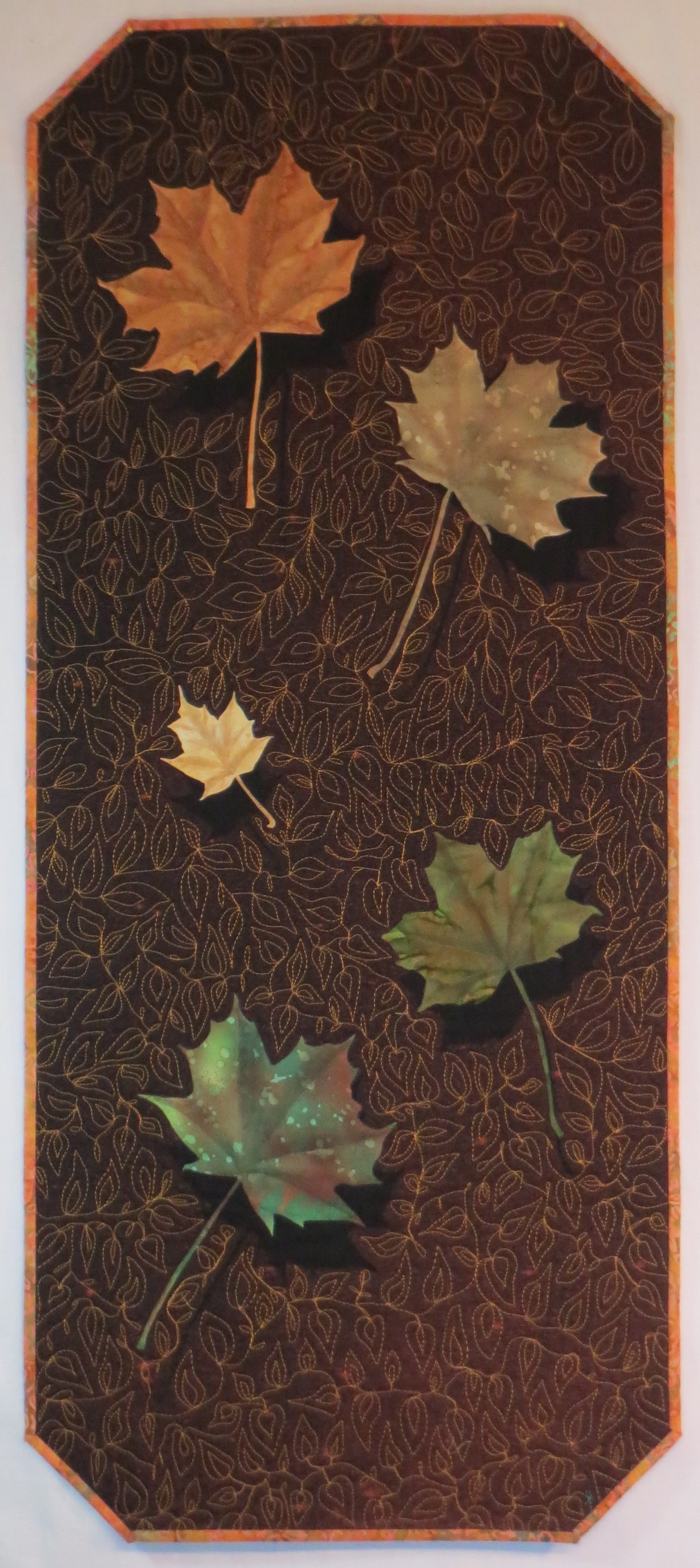
Anyway, this reminded me of the class I took from Barb years ago, which involved use of Tsukineko inks and also fabric discharging.    Here is a photo of the quilt I completed in that class:

Leaf shadow quilt

Leaf shadow quilt

In a future post I will be showing how to make those angled corners on the binding, because someone at my guild asked me about that recently.  It is covered in my binding book (the techniques work for any angle) but since this kind of corner is fairly common on tablerunners, I will put up a post with step by step photos for this specific corner.  Stay tuned!

And here is a closeup of the shadow and quilting detail in the leaf quilt:

Leaf shadow quilt detail

Leaf shadow quilt detail

The detail photo shows the shadows behind the leaves ( a bleach discharge technique; see Colleen Wise’s book Casting Shadows for details) and also shows the very subtle veining in the batik leaves that was accomplished with Tsukineko inks, courtesy of Barb’s great lessons in her class.  I am also very fond of the free motion quilting in this one.  The gold rayon thread worked very nicely with the rusty orange discharged fabric (which started out as solid black before discharging; the black shadows under the leaves are the original fabric color).  And I am very fond of leaf quilting patterns, which can be done with no marking and almost always turn out great.

I don’t know if Barb is teaching this particular class any more, but it was one of my favorites.  Tsukineko inks are great for many things, adding both bold and subtle detail to a quilt.  Once ironed, the color is permanent.

Here are a couple of links if you want to get Colleen Wise’s book or need an online source for Tsukineko inks:

Colleen Wise’s book:  Casting Shadows: Creating Visual Dimension in Your Quilts

Tsukineko ink sets: Tsukineko All-Purpose Ink Workstation Set  This set is fairly expensive  ($100+) but does give you lots of colors and everything you need to get started, including an instructional DVD.  You can probably buy the ink and applicators through your local quilt shop to try them out without such a big commitment.  The inks are also sold as Fabrico markers, if you want the color in something more like a felt tip pen.  The markers would be great to add an accent color to a fabric — say you had a black and white print and wanted to add just a touch of color – a pop of red or yellow on a flower petal or inside a circle.  Lots of creative options to think about.

Quilting with a Walking Foot class samples

I recently finished a couple more class samples for display in the shops where I teach classes.  These show students what they will learn in my beginning quilting class.  This is the class most suitable for quilters who have either never sandwiched and quilted a quilt, or have done a few and not been satisfied with the results.

The first quilt is on a dark rusty brown fabric, mostly quilted with a copper colored rayon thread:

Beginning Machine quilting class sample

Beginning Machine quilting class sample

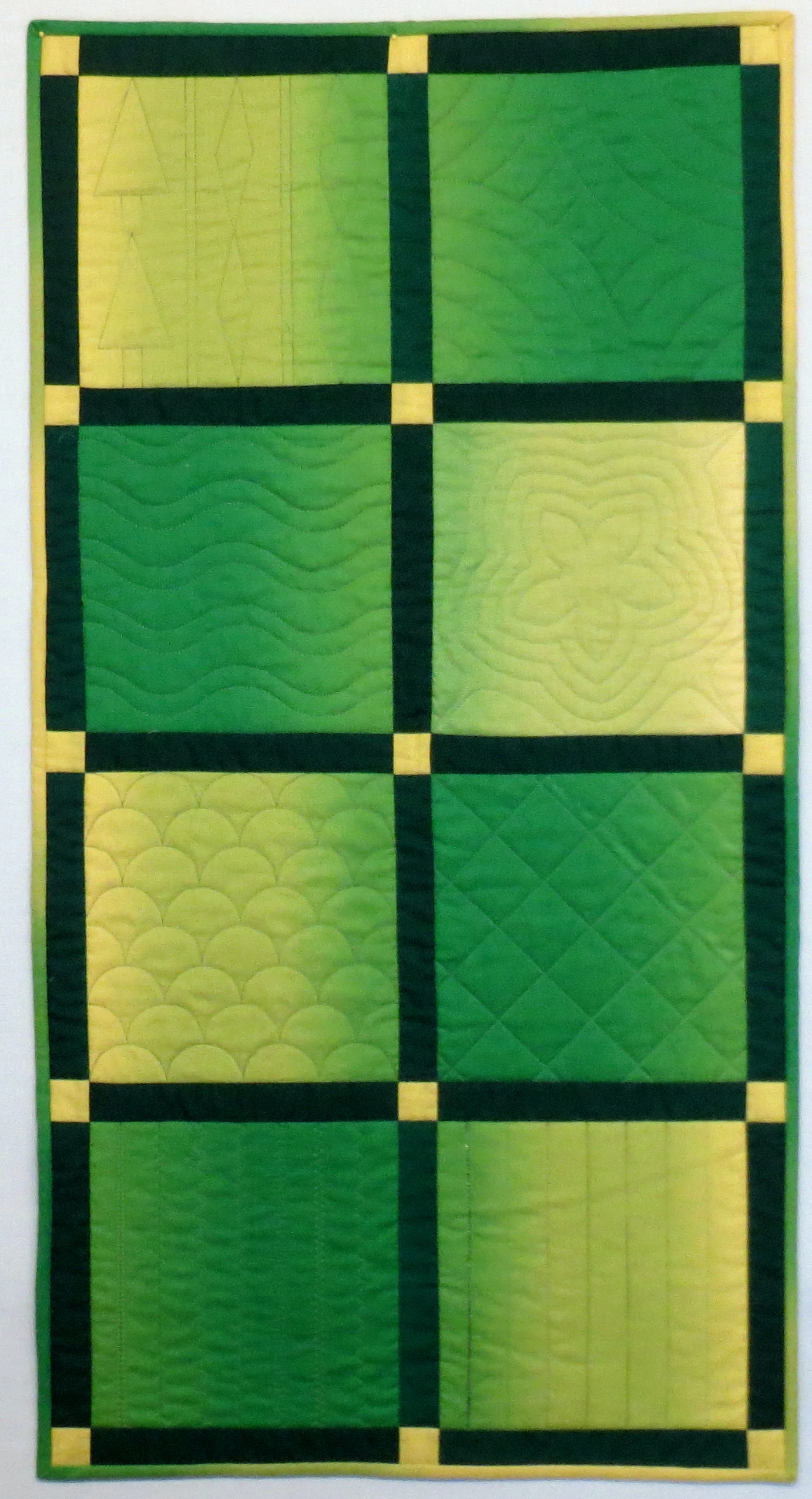
The other sample was done on an ombre fabric and I really like the result.  Thanks to Susan Travis from Creative Union for suggesting this fabric from her sale rack!

Green Beginning Machine quilting class sample

Green Beginning Machine quilting class sample


Quilting with Decorative Stitches from your sewing machine

Quilting with decorative stitches is a great way to add an accent to your quilt, especially along a border or in place of “stitching in the ditch” on a casual quilt.  Some decorative stitches can be used with your walking foot, but only if the stitching always moves forward.  Some decorative stitches can only be made when the feed dogs force the fabric to move backwards or even sideways.  These stitches cannot be done with the walking foot in place, since the walking foot moves the fabric in the usual front-to-back direction only.

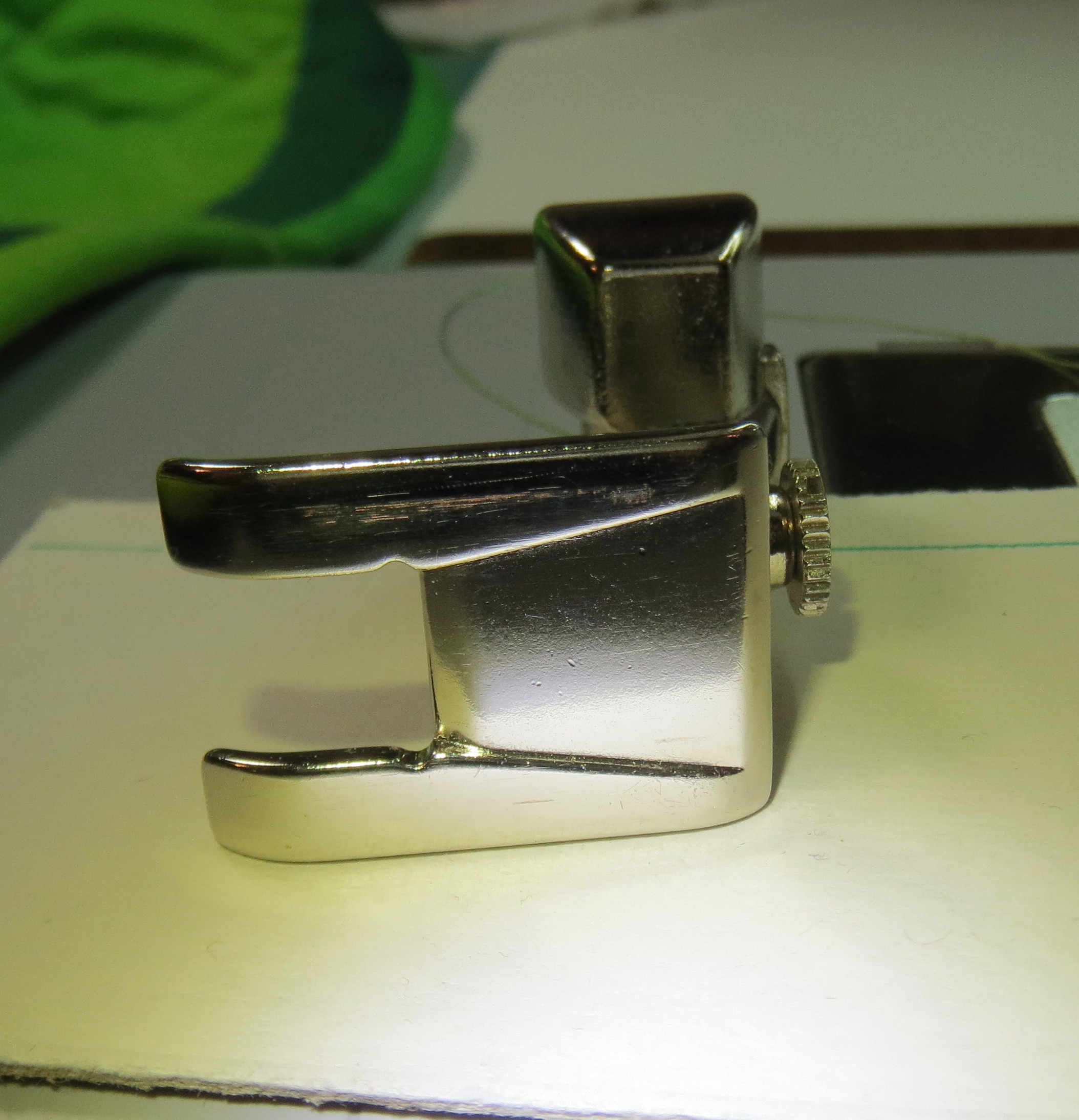
For these decorative stitches, another presser foot must be used.  The best foot to select is an open-toed satin stitch or embroidery foot, such as the one shown below.  The photograph shows a Bernina foot for my machine that has a 9 mm stitch width; if your machine has a narrower stitch width, your foot will also be narrower.  The embroidery foot can be distinguished from other feet by the groove on the bottom, shown in the right hand photo.  The groove allows a dense stitch that stands above the fabric to move under the foot smoothly.

Open toe embroidery foot

Open toe embroidery foot

bottom view, embroidery foot

bottom view, embroidery foot


Without the walking foot, the quilt top fabric will tend to be pushed forward relative to the batting and backing.  Eventually when you reach a previously stitched line this will result in a pucker or fold.  Avoiding puckers requires more careful pinning along the stitching line.  This can be done by pinning the stitching area for six inches or so ahead of the stitching, as shown in the photo below.  I use large pins for this purpose so they are   easy to pull out right before the needle reaches them.  As they are removed, they can be placed further along the stitching line.

Temporary pins ahead of stitching with the embroidery foot

Temporary pins ahead of stitching with the embroidery foot

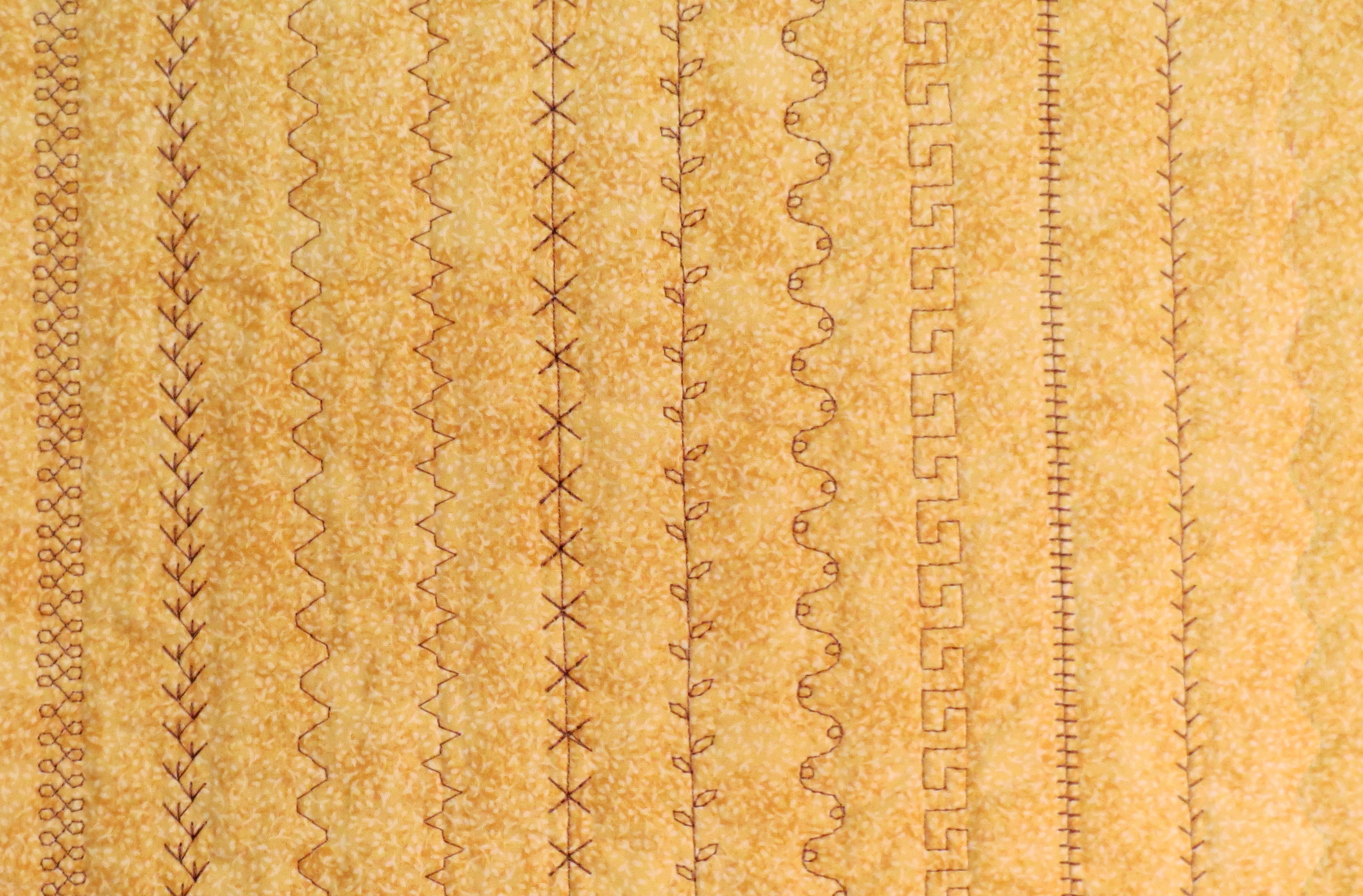
And below is an example of some decorative stitches I like for quilting.  None of these stitches is very dense, so they are relatively fast to stitch and look good on the back of the quilt as well as the front.  I particularly like the serpentine stitch (basically a wavy line), a simple feather stitch, and a simple leaf stitch.  You may need to adjust the stitch width and length before they make an attractive quilting stitch.  Be careful to check your tension on a scrap piece before stitching; sometimes the default tension on a decorative stitch is set loose so the top thread will go to the back and no bobbin thread will show on the top.  Since we will be seeing the quilting stitches on the back as well, we need to balance the tension, especially if the top and bobbin threads are different colors.

Some decorative stitches suitable for machine quilting

Some decorative stitches suitable for machine quilting

If I don’t want to take the time to bury knots at the start and stop, I ensure an attractive start and stop by first stitching 5 or 6 tiny straight stitches.  Then I change to the desired decorative stitch and continue until I am within about a millimeter of the end.  I then change back to a straight stitch and make a few tiny stitches.  The closeup photo below shows this area; the straight stitching is not noticeable and provides the necessary locking of the thread so it won’t unravel.

Begin and end the decorative stitch with 5 or 6 tiny staight stitches to lock the thread

Begin and end the decorative stitch with 5 or 6 tiny staight stitches to lock the thread

Try some decorative stitches on your next quilt.  Several of them are great substitutes for stitching in the ditch, if you have trouble keeping your stitches in the ditch!

Joining the ends of double fold bindings

As I was doing research for my binding book, I found many methods for joining the ends of the binding together.  Some of them require a special tool and others require calculations involving the width of the binding strip, making 45 degree cuts on the end of the binding, etc.  When I discovered the method I include in my  book, I couldn’t believe how simple it was compared to all the other methods.

As I teach this method in class I have learned that I needed a little more explanation than I included in the book.  Someday I will update the book, but I have written a little tutorial with lots of extra photos for my students.  I am posting it here now so it will always be available.

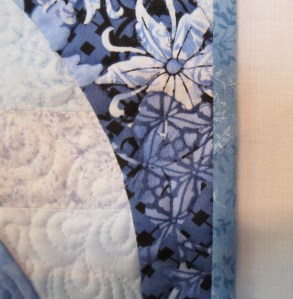
Here is what a perfect end binding end join should look like.  The end join is on the right side, about in the middle.  Can you see the diagonal seam?
A perfect end join is nearly invisible

A perfect end join is nearly invisible

Often the other methods taught either leave an unattractive lump or straight seam. My method does not require special tools or measurements.  It works for all double fold (also known as French fold, or “flip and fold” bindings), regardless of width or seam allowance.  Details of this technique and a thorough explanation of all aspects of binding or edge finishing a quilt without bindings are found in my book, “Fast Fabulous Quilt Bindings” available for sale on Amazon.  Go to the “Books” page of this blog for a direct link to the book.

Don’t be intimidated by the length of this tutorial.  Once you learn the method, the whole process will take about five minutes.  It takes way longer to explain it here than it does to do it.  If you were sitting here with me, I could explain it quickly!  But for this post  I have to include way more pictures than you probably need, just so it is clear to everyone.

The tutorial does assume you know how to apply a “flip and fold” binding.  If you don’t, get a quilting friend to help you or, of course, you can purchase my book where it is all explained in detail.

A few notes to help you:

–          I have used one fabric (cream) for the beginning tail and a different fabric (soft green) for the ending tail, to make the photos easier to understand.

–          I have oriented the quilt and binding tails in all the drawings and photos so that the quilt edge is vertical (lined up as if about to be stitched in the sewing machine).   If clipping or pinning in this position is awkward for you, rotate your quilt temporarily to accomplish the desired step.  Then re-orient to match the pictures. 

–          The binding attachment process will be easier if you use an open-toe walking or dual-feed presser foot.   The open toe feature helps you see better.

–          For step 5, handling the binding will be easier if you pleat the quilt along the edge, as shown in the photos.  You can hold it with a clothespin or a large straight pin if needed.

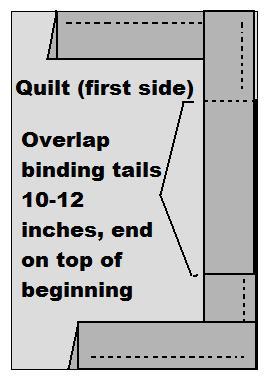
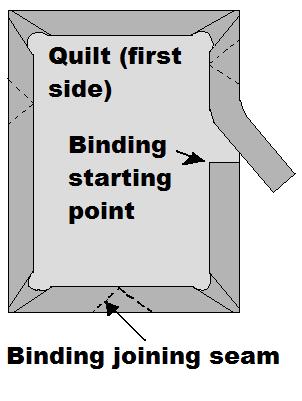
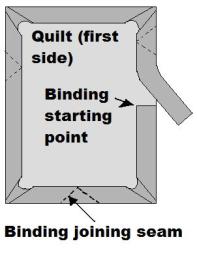
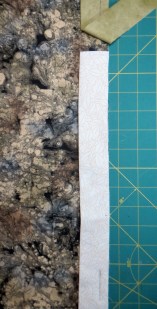
1. Step  One.  When you attach the binding, leave a 12 inch unstitched tail at the beginning, as shown in the photo and drawing below.  NOTE:  (first side) in the drawings means the quilt side you attach the binding to first – usually the quilt top, but for machine applied  bindings some quilters attach to the quilt back first.
Leave a 12 inch unstitched "tail" at the beginning of your binding

Leave a 12 inch unstitched “tail” at the beginning of your binding
Leave a long unstitched "beginning" tail on the binding

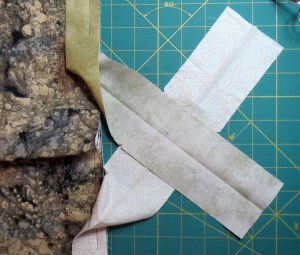
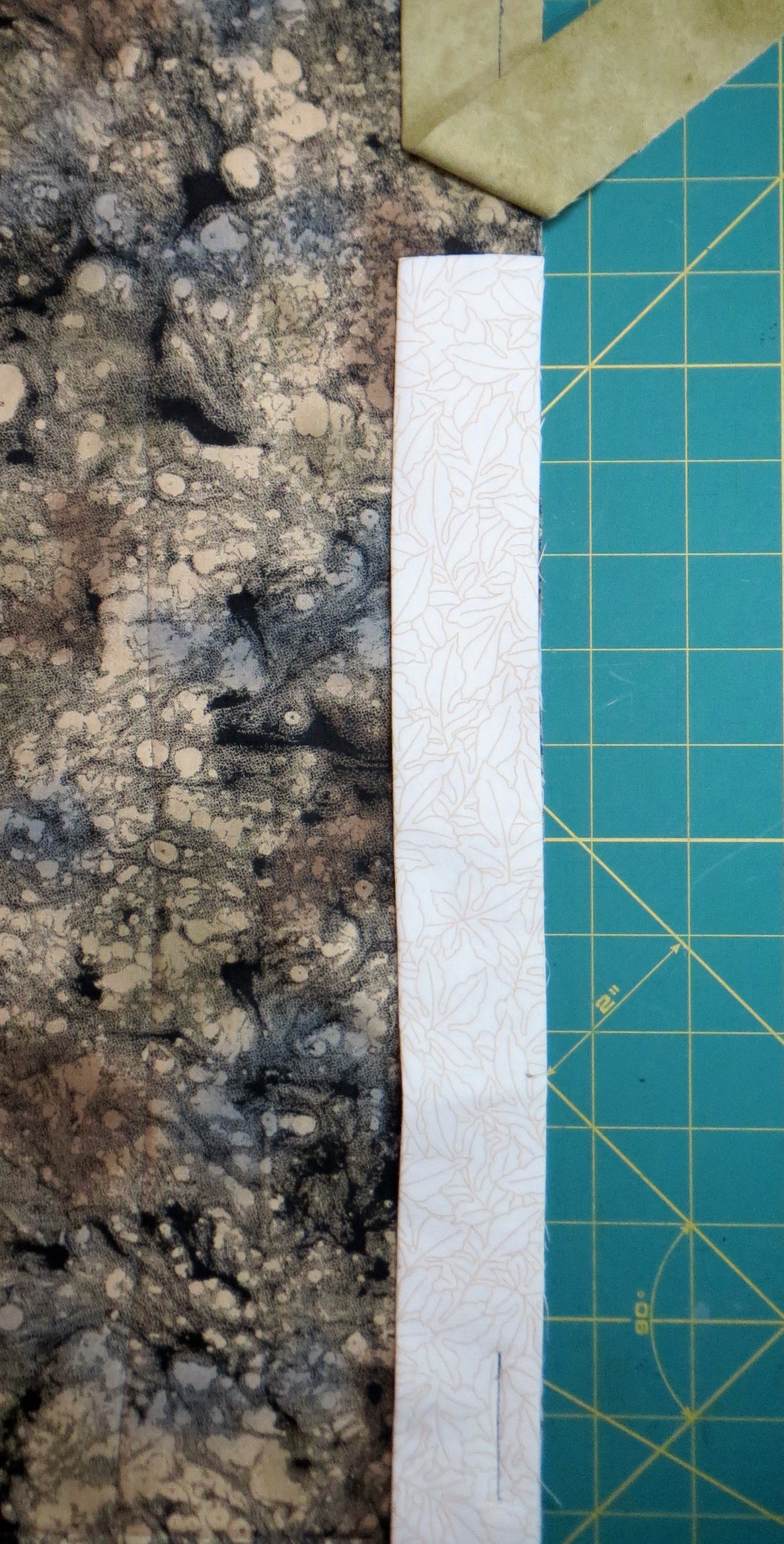
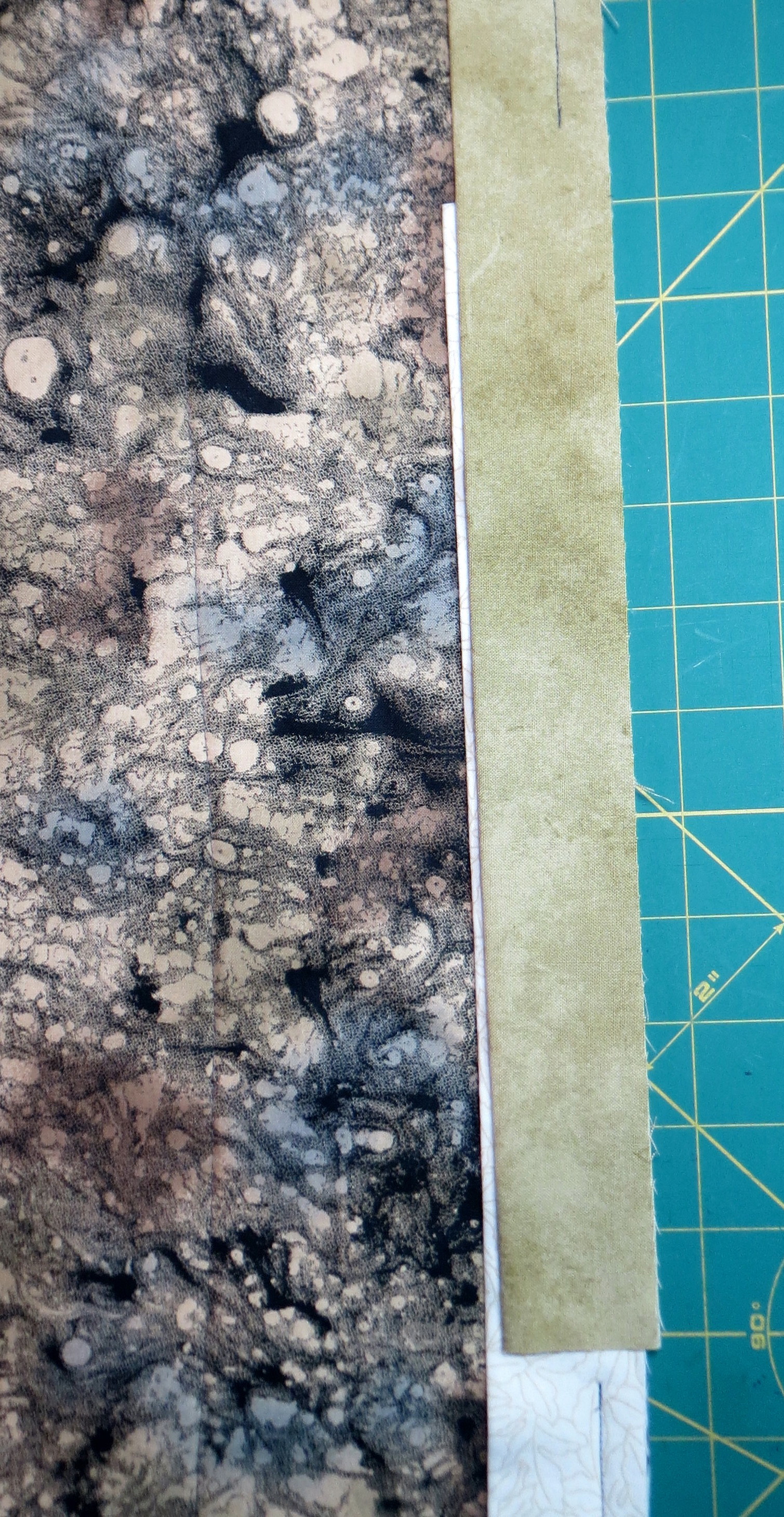
2. Step Two.  Leave about 12 inches of unstitched gap where the two tails come together. Do not skimp on this distance!  If you are using an extra wide binding, make the gap even larger – 15 to 18 inches. In the photo below, the cream color is the “beginning”  tail of the binding; the soft  green is the “ending” tail.
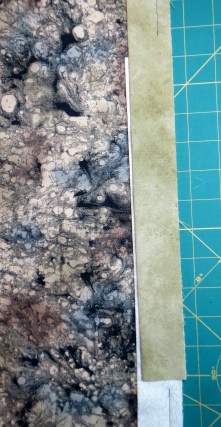
Place ending tail on top of beginning tail along quilt edgeOverlap the unstitched binding tails

Place ending tail on top of beginning tail along quilt edge

3. Step Three.  Trim the tails so that they are within the unstitched area and lay flat together.

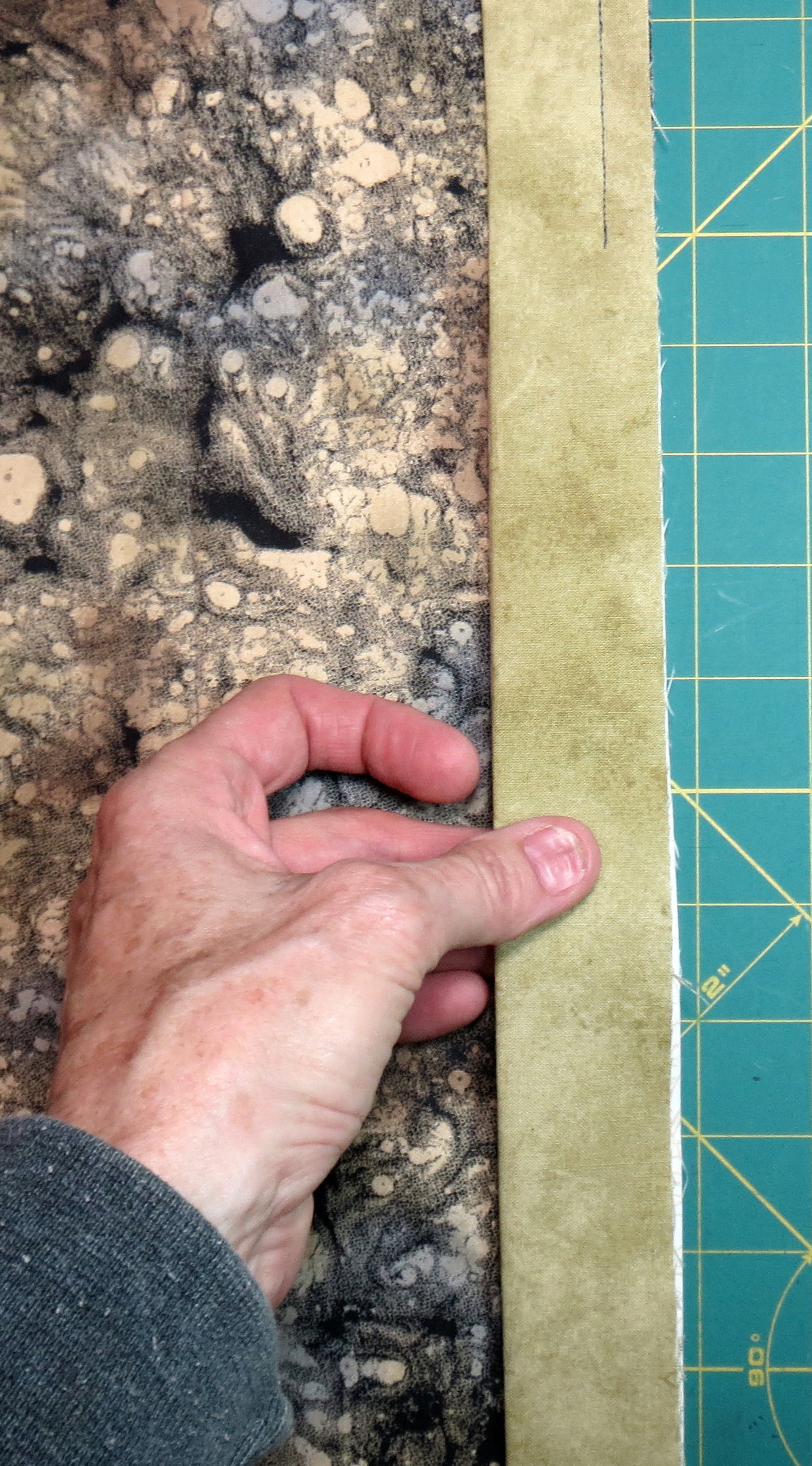
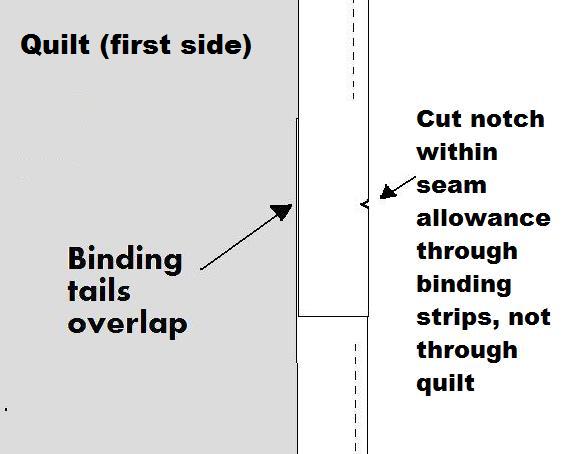
4. Step Four. Line up the two binding ends perfectly, one on top of the other.  Pinch the two binding tails (four layers of fabric) between your fingers  (about in the middle of the unstitched gap) and clip a 1/8 inch deep notch in the raw edges of all four layers, as shown in the drawing below.  DO NOT CLIP the edge of your quilt;  just the four layers of binding.
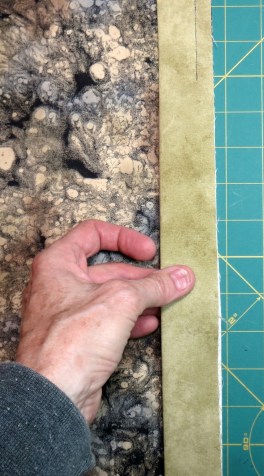
Pinch all four layers of the binding tails between your thumb and forefinger
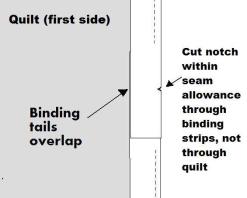
Pinch all four layers of the binding tails between your thumb and forefinger

FFQB 14 Nov 16 2012

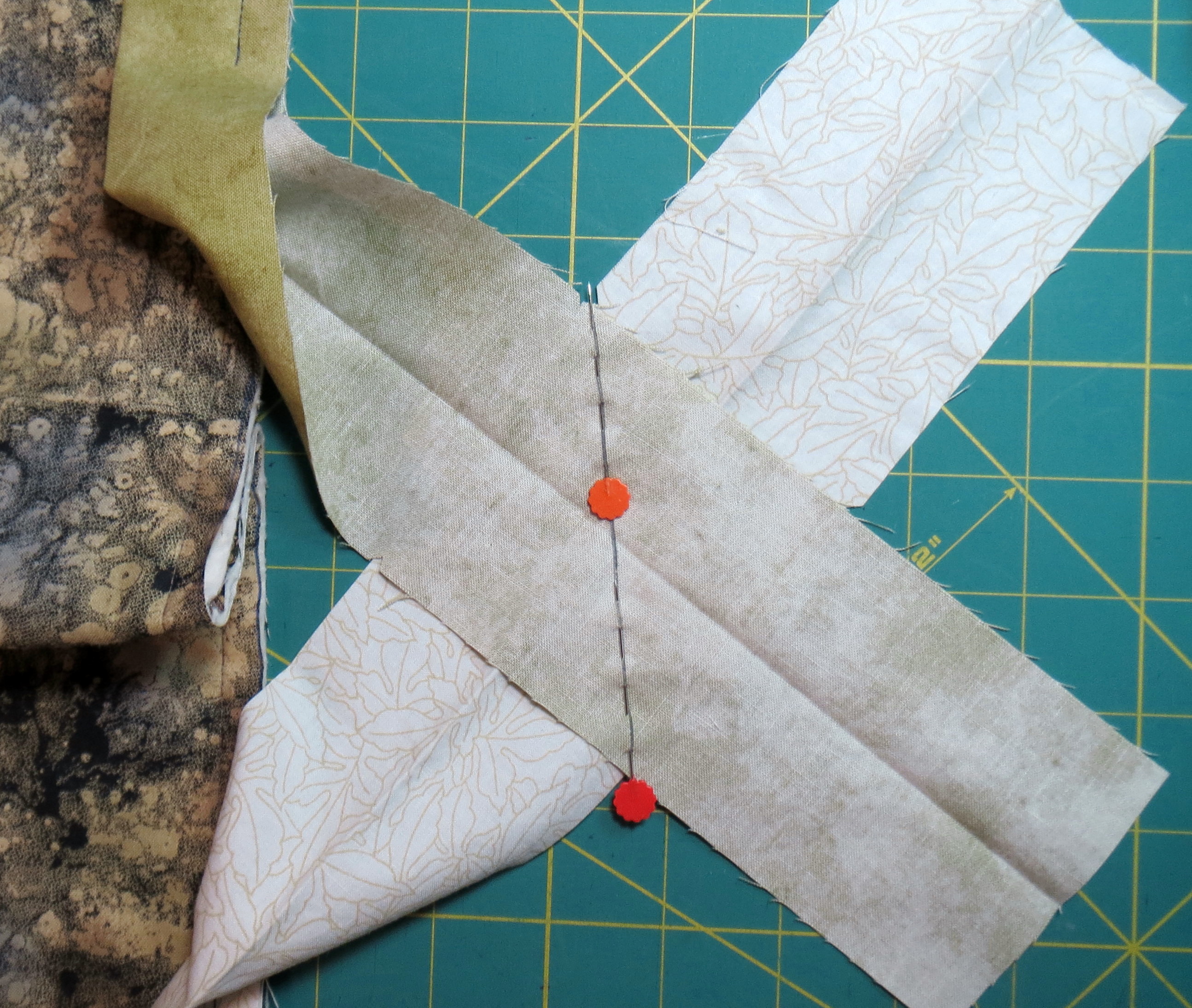
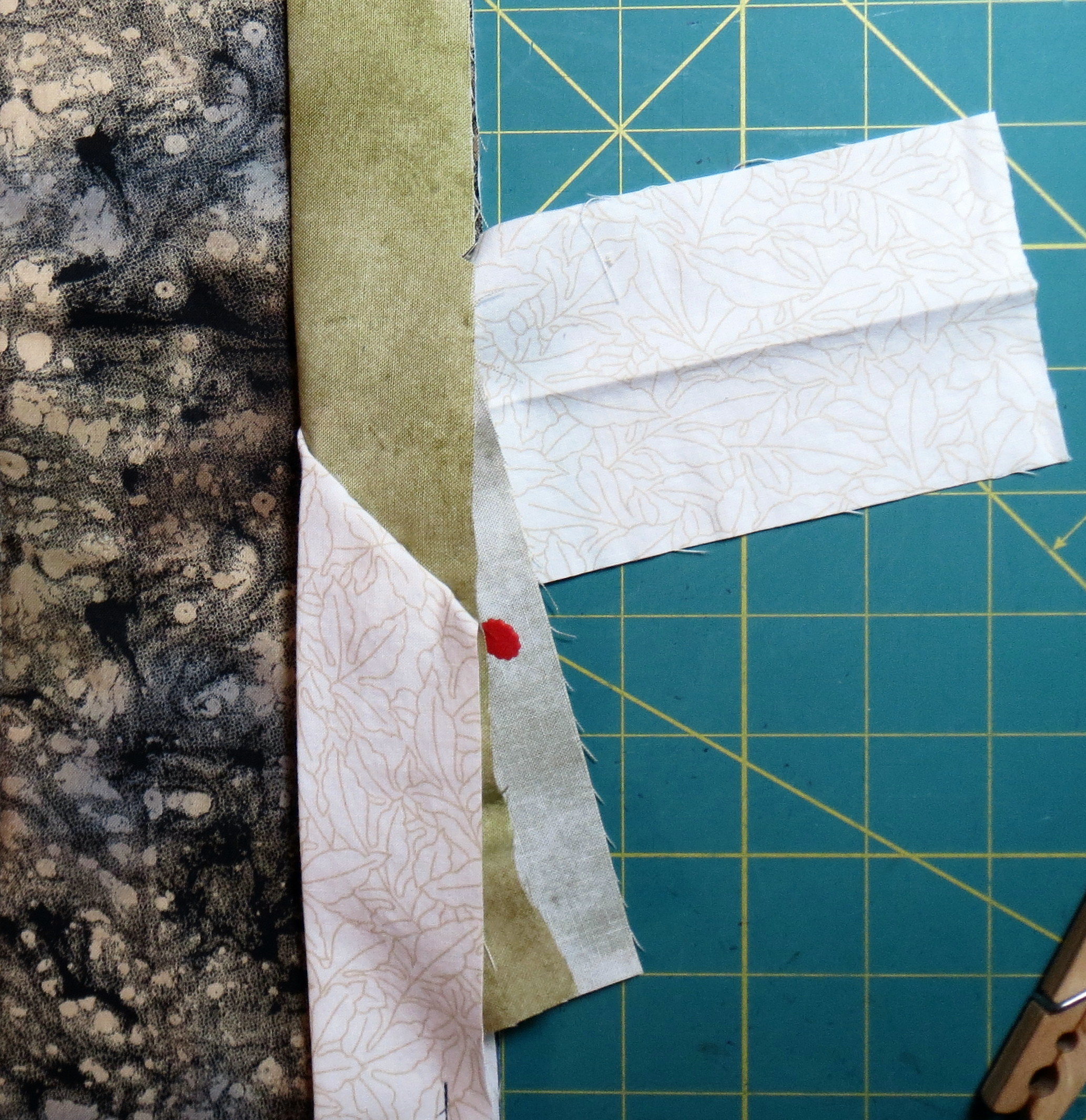
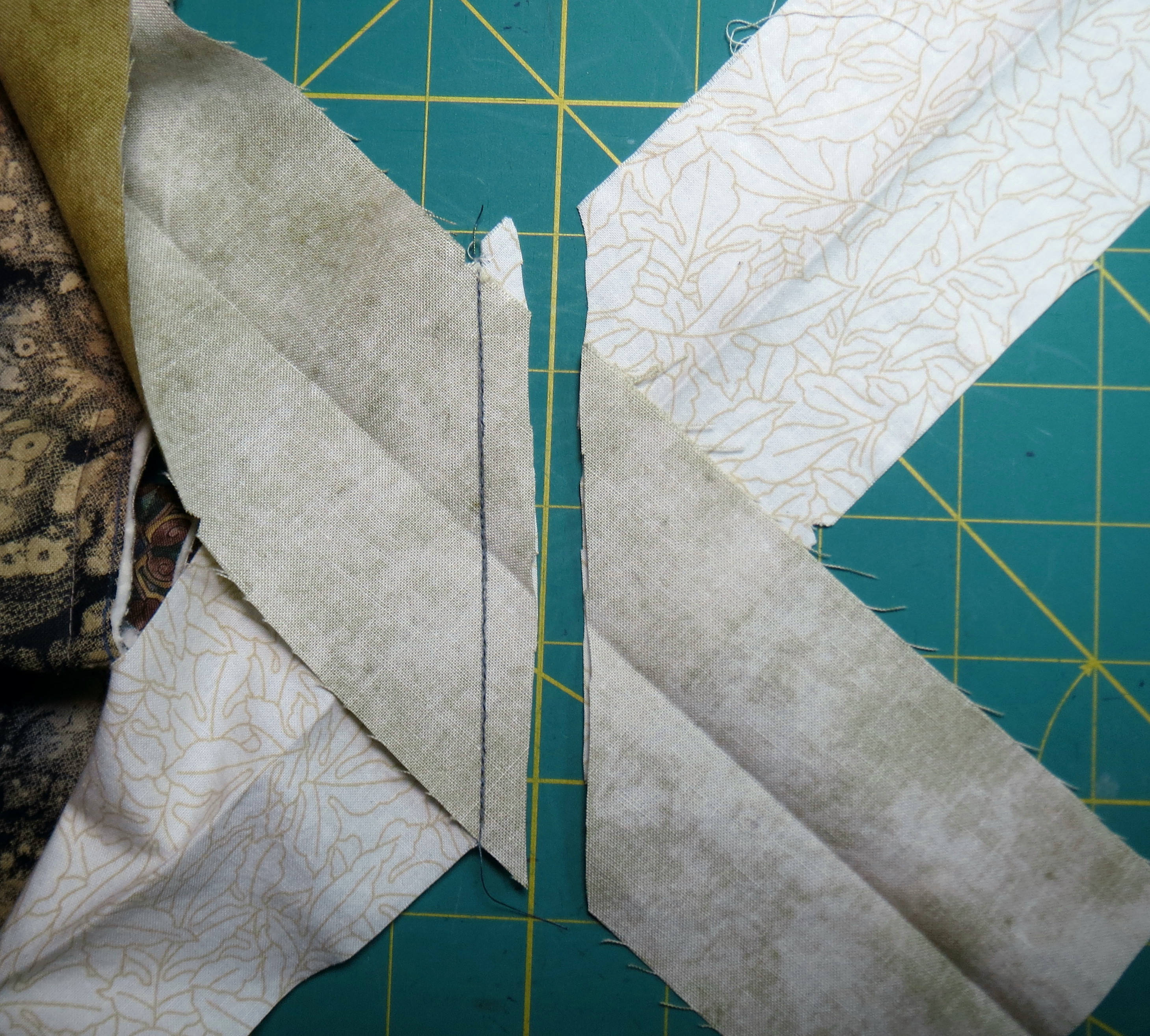
5. Step Five – Make a pleat in the quilt edge (this makes bringing the binding ends together easier) and then open up the binding tails.  Place the beginning tail right side up and the ending tail wrong side up on top of it.  Line up the notches.  Shown at the top where the two binding tails come together, you can see a notch in each tail.  On the left, a notch in the ending tail lines up with the edge of the beginning tail.  On the right, a notch in the beginning tail lines up with the edge of the ending tail.
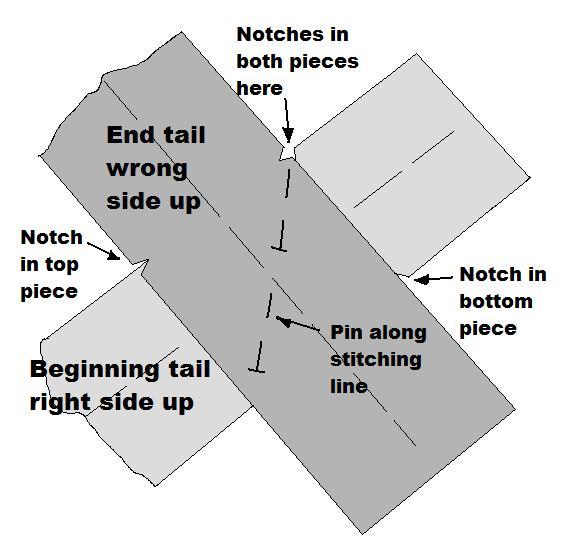
FFQB 15 Nov 16 2012

Binding end join step 5 Aug 18 2013

If desired, draw a line along the diagonal stitching line as shown in the photo below.  The proper diagonal is parallel to the edge of the quilt.
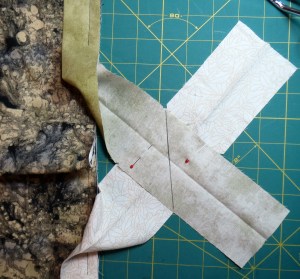
Mark the stitching line along the diagonal parallel to the quilt edge

Mark the stitching line along the diagonal parallel to the quilt edge

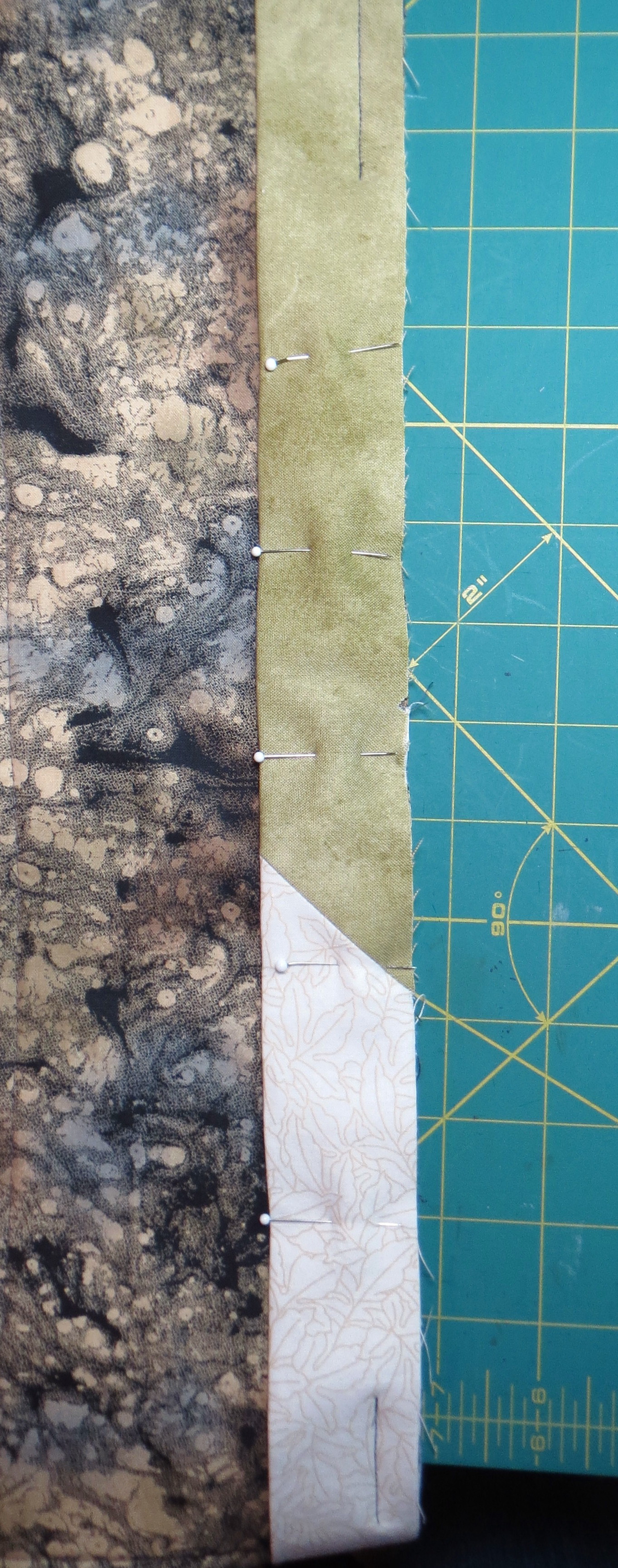
Place one pin on the marked diagonal on each side of the binding center fold.  Keep these pins clear of the binding fold.  Remove any pins in the binding that are not along the marked sewing line.

Pin along the stitching line and remove any other pins

Pin along the stitching line and remove any other pins

6. Step Six.  Test the binding by smoothing out the quilt edge (unpinning if you pinned it)  and folding the binding on the center fold.  The binding should lay flat without any twists.  If it doesn’t, you have probably twisted one of the tails.  Go back to Step Five and proceed with the steps again.
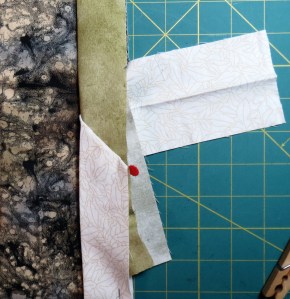
Test the pinned seam line by folding it in place along the quilt edge.  It should lay flat except for the extra fabric inside the fold

Test the pinned seam line by folding it in place along the quilt edge. It should lay flat except for the extra fabric inside the fold

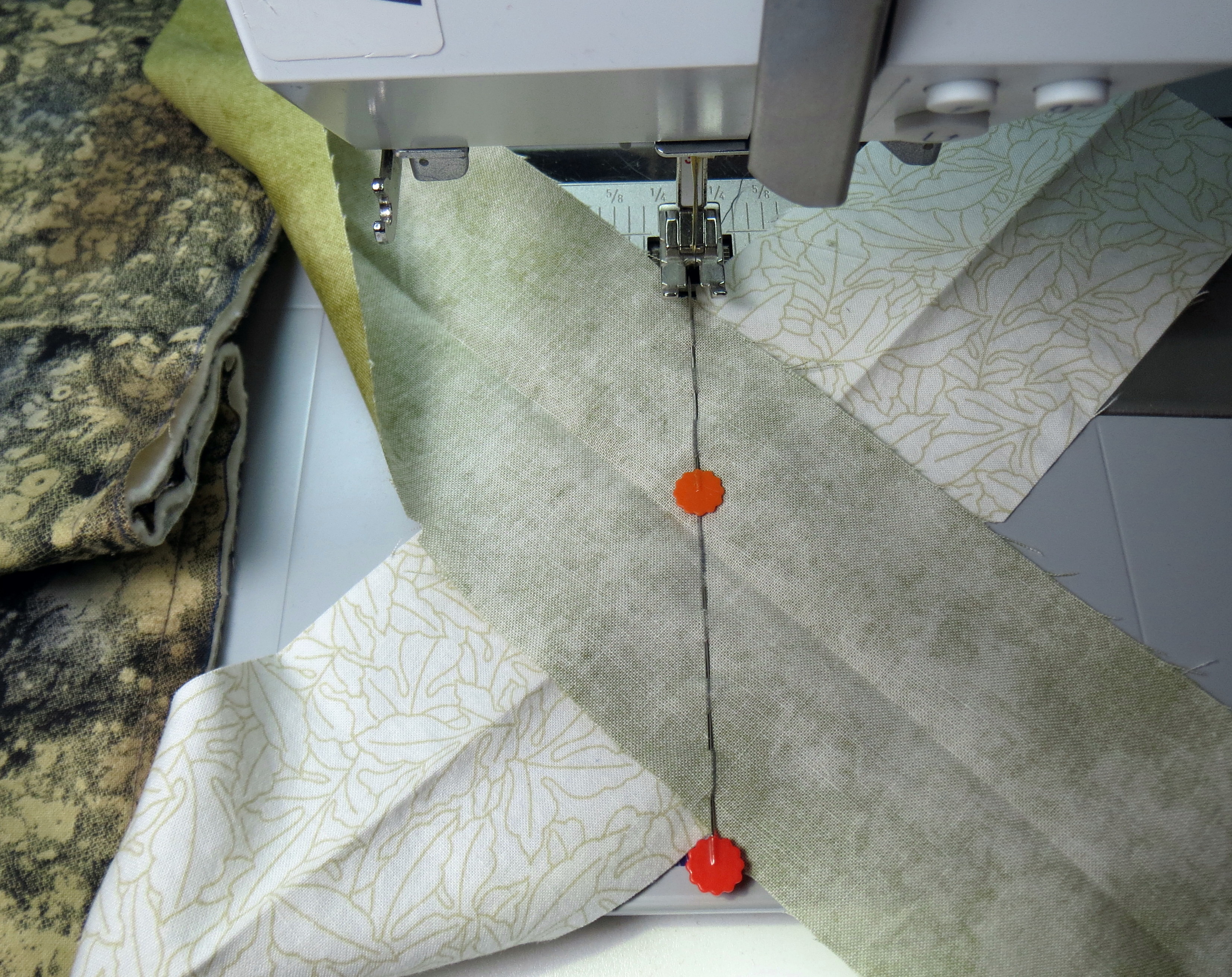
7. Step Seven. Open up the binding again and stitch along the marked line.  Remove the pins as you stitch; or relocate the pins away from the stitching line before you sew.
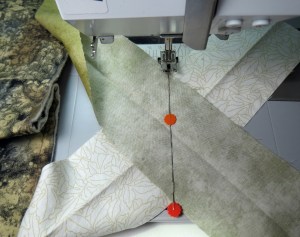
Sew along the marked line, carefully removing the pins as you sew (or put additional pins to the side)

Sew along the marked line, carefully removing the pins as you sew (or put additional pins to the side)

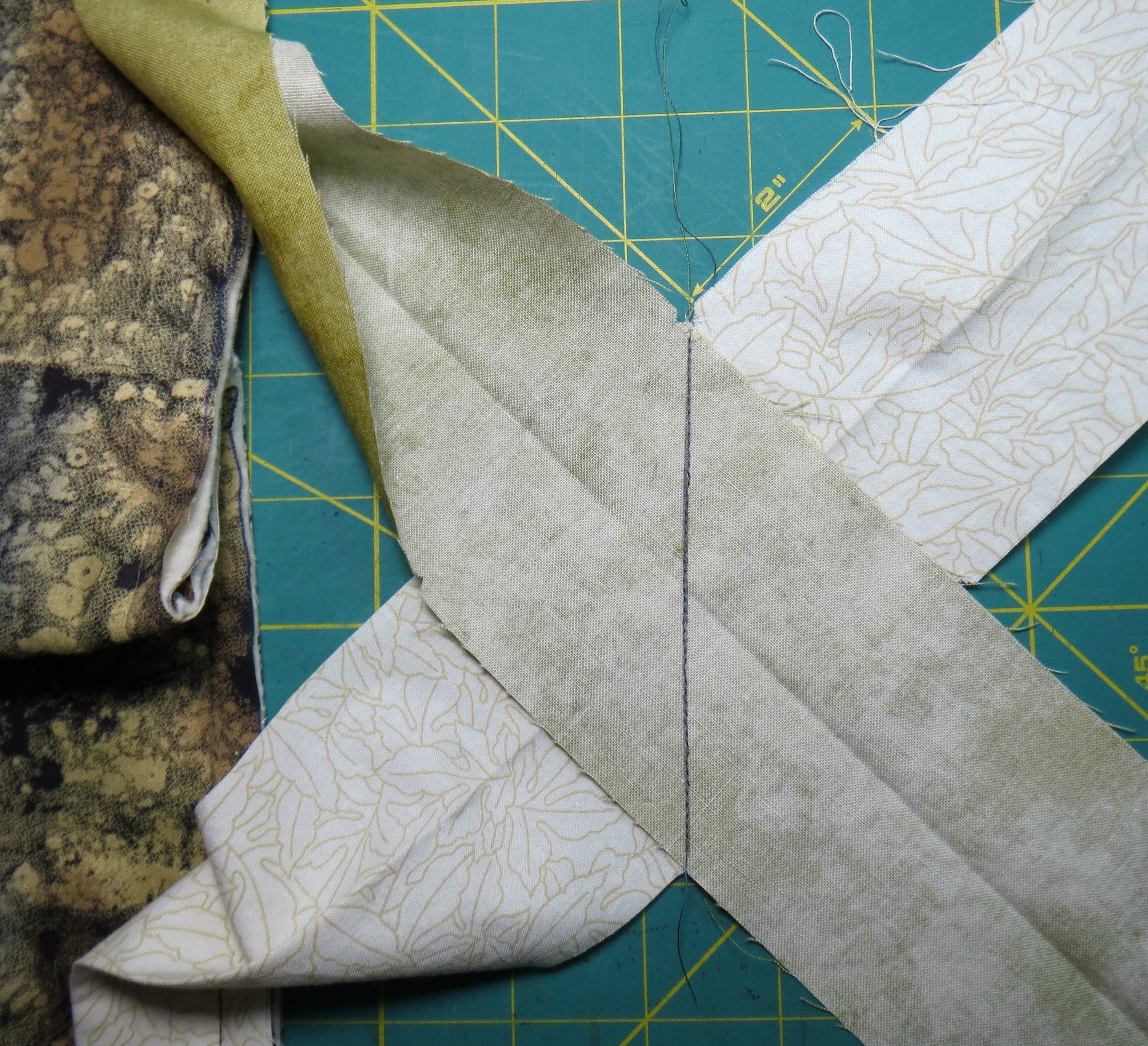
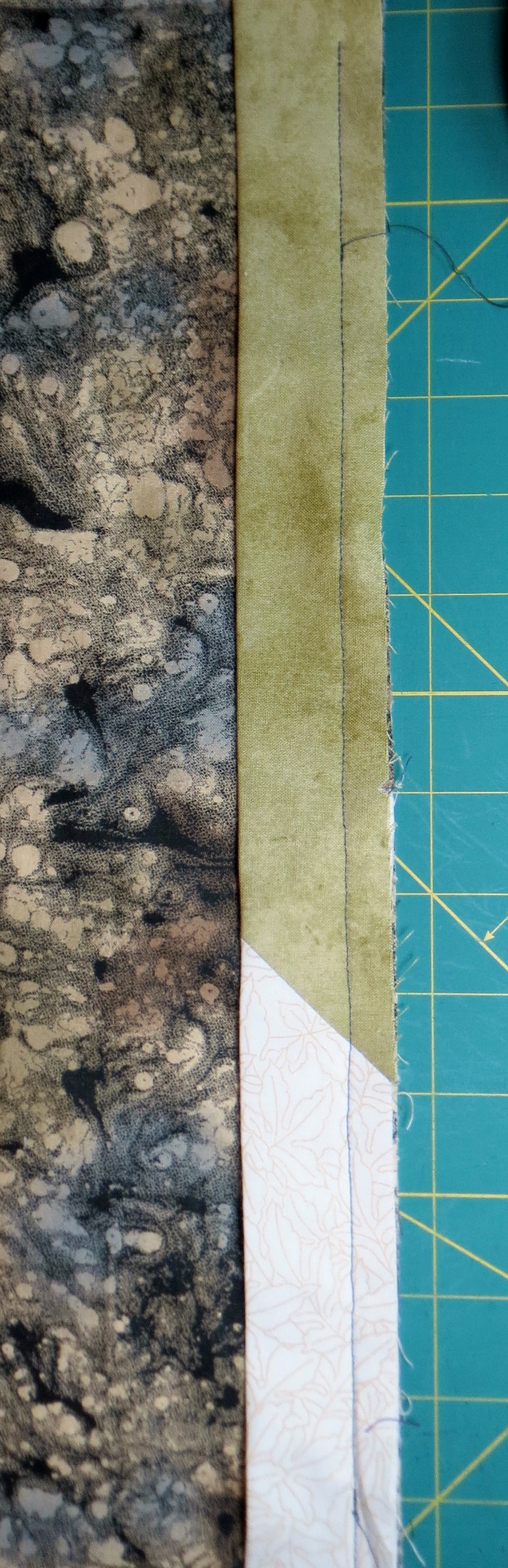
The stitched line is shown below:
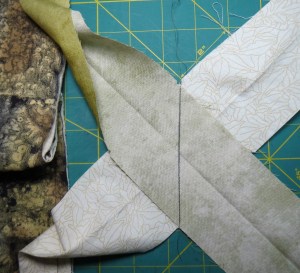
Completed stitching along the join

Completed stitching along the join

8. Step Eight.  If desired, test the binding by smoothing out the quilt edge again.
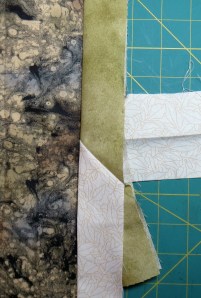
Testing the stitched seam against the quilt edge

Testing the stitched seam against the quilt edge

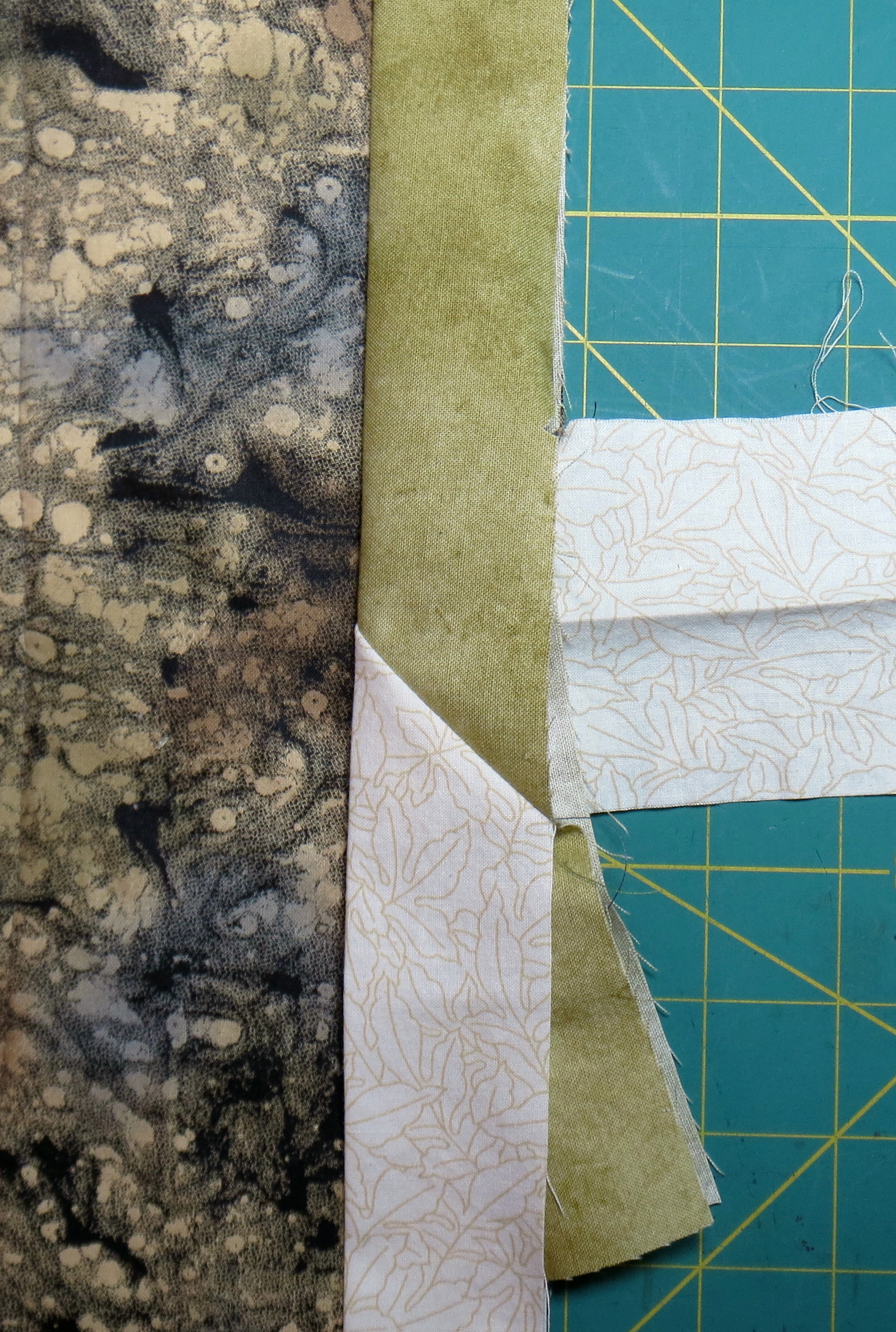
9. Step Nine.  Trim the tails to a ¼ to ½ inch seam allowance.  The exact seam allowance isn’t critical. Press the seam.  then press the binding fold.
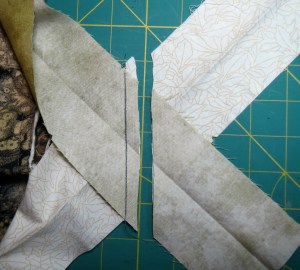
Cut the loose ends to make a 1/4 to 1/2 inch seam allowance

Cut the loose ends to make a 1/4 to 1/2 inch seam allowance

10. Step Ten.  Pin the binding to the quilt edge every 1-2 inches.  Use the closer spacing if you do not use a walking foot.  With a walking foot, pins every 2 inches should be sufficient.
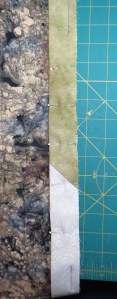
Pin the binding to the quilt every 1-2 inches

Pin the binding to the quilt every 1-2 inches

11. Step Eleven.  Sew the binding to the quilt between the previously stitched areas.  Backstitch at each end.  Your binding join is complete!
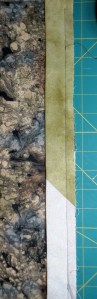
Completed binding end join

Completed binding end join

If you try this method, I would be interested in hearing your feedback.  If you have questions, email me at shirley@mysterybayquiltdesign.com and I will try to answer them.  Your questions will help me understand where my explanation needs to be improved, so please do not hesitate to write.

Book review: First Steps to free-motion quilting by Christine Cameli

I have just read a new book on Free Motion Quilting.  This book, “First Steps to free-motion quilting” by Christine Cameli and published by Stashbooks, is intended to be just what the title says:  a beginning free motion instruction book.  As a bonus, it includes 24 simple projects that are designed to be quick to make so that you can spend a minimum of time making the project and most of your time practicing your free motion quilting.

The instruction section is short but complete.   The photos are good and the writing clear.  Extensive use is made of bulletized lists so that you can quickly see the important ideas without wading through lots of text.  In fact, as I read the instructions I found the author making all the same points I tell my students in my free motion classes.
Following the instructions, a thoughtfully organized section shows about 65 different free motion designs, all very suitable for beginners.  This section is a wonderful resource for quilting ideas.

The remainder of the book – in fact more than half of it – is devoted to the 24 projects.  There is a wide variety – bags, bowls, placemats, tablerunners, clothing, and quilts.    The last part of the section discusses embroidery – or using the free motion designs on plain cloth or readymade clothing.  Many of the projects have a “modern quilt” feel.  They are young and fresh and are likely to appeal to younger quilters (Judging by her photo, the author  fits in this category!)

In short, I heartily recommend this book.  I will be telling my free motion students that this is the one book they should buy as a reference.  You can  purchase this book at Amazon through the following link: First steps to free-motion quilting

Free Quilt Patterns and Designer at Equilter.com

I recently received a newsletter from Equilter.com featuring their free quilt designer.  It has some nice features and is a great way to get a free pattern and shop for fabric at the same time.  You can go see it at the following link: http://www.equilter.com/pattern/category/0/equilter-free-pattern-designer

There is also a short video showing how to use it.  Be sure to watch the video, it is short and a good explanation of how the software works. This is not truly quilt design software like Electric Quilt (which is great but costs money), but it is essentially a library of quilt designs that allow you to access the design, see what fabrics were used for the original design, change the fabrics to others available at Equilter, see how much fabric is needed and how much the fabric will cost, download complete instructions, or email your version of the quilt with instructions to yourself or a friend.

There are over 400 patterns available with more being added frequently.  Most of these patterns are ones created by the fabric manufacturers to feature their new fabric lines.  The software that Equilter has developed allows you to take that pattern and see how it will look with other fabric choices.

This is a great added feature to the Equilter website, and a very efficient way to access all those free patterns made available by the manufacturers.

Based on the email newsletter I received, Equilter will be sending out newsletters  announcing new patterns as they are added.  If you aren’t already drowning in emails from quilting websites, you might want to get on their mailing list.

Machine Applique with Silk Thread – Update

In the last post I mentioned that I was going to try spray starching my block instead of using a tear away stabilizer on the back.  I did try that, and it worked beautifully.  So no more stabilizer!  That saves a tedious step in the process.  I would still want to use the stabilizer if I were doing a satin stitch, but for the blanket stitch it is not necessary.  After starching all the light squares for my quilt, I finished the stitching on all the applique.  For these blocks, I had spray starched the applique fabric (on the front, to avoid affecting the fusing process) and thus had a minimal amount of fraying around the pieces.

I am now working on the dark blocks.  In my rush to make the blocks, I managed to forget about starching the applique fabrics ahead of time.  My first machine stitching resulted in a lot of fraying and I was not happy with the result.  So the next thing I tried was to spray starch the whole block, front and back.  This avoided the need for the stabilizer and also resulted in a much cleaner look to the applique on the front, as you can see by comparing the two photos below.

Applique fabric not starched

Applique fabric not starched

Entire block starched front and back before stitching


I think there is going to be a lot more spray starch in my future.  Before committing to it I will have to rinse out a couple of blocks and make sure the fraying doesn’t happen later, but so far I am pleased with the results.  This is a much faster way to get a good result.  Of course if you do this be careful about breathing the fumes!

Machine Applique with silk thread

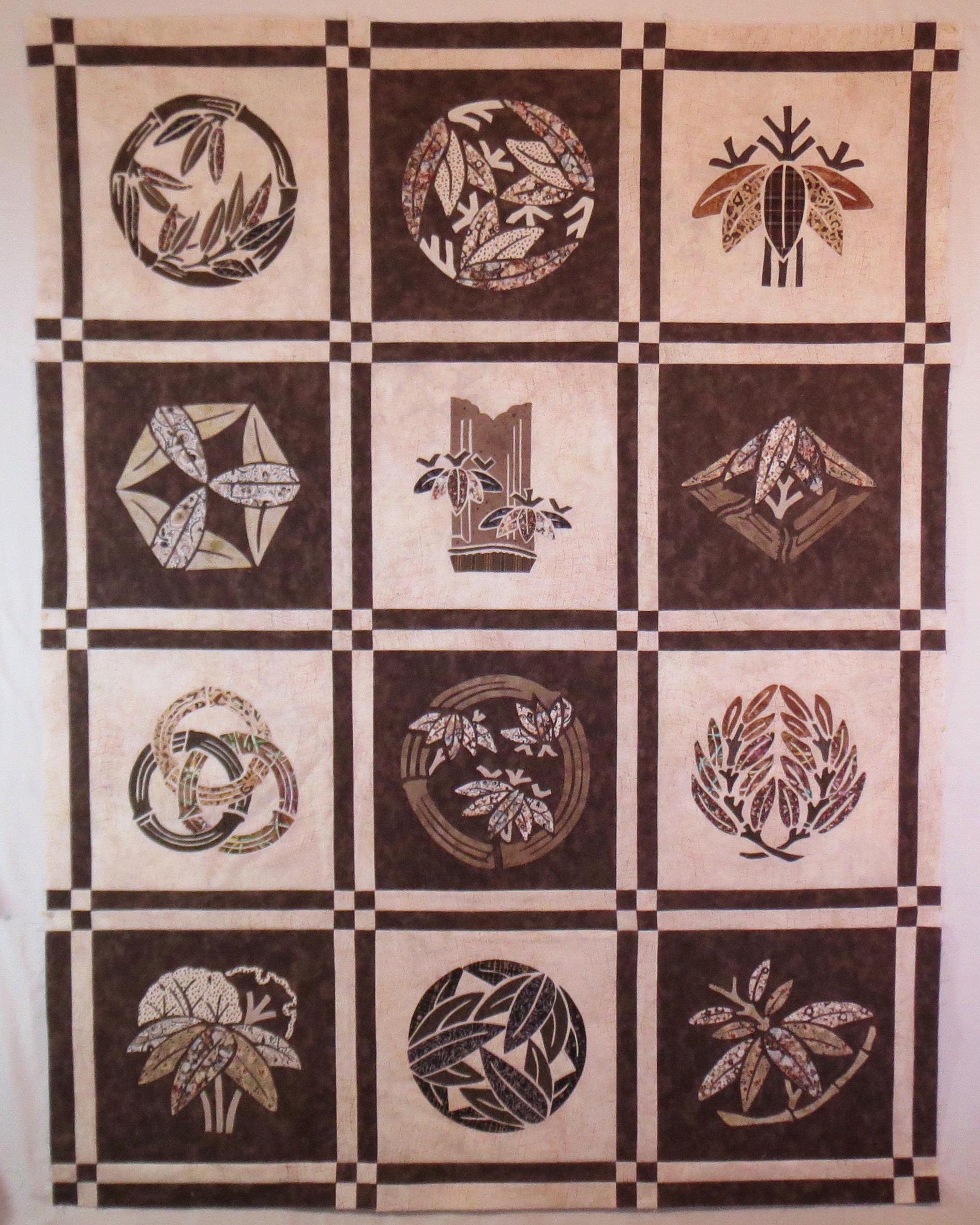
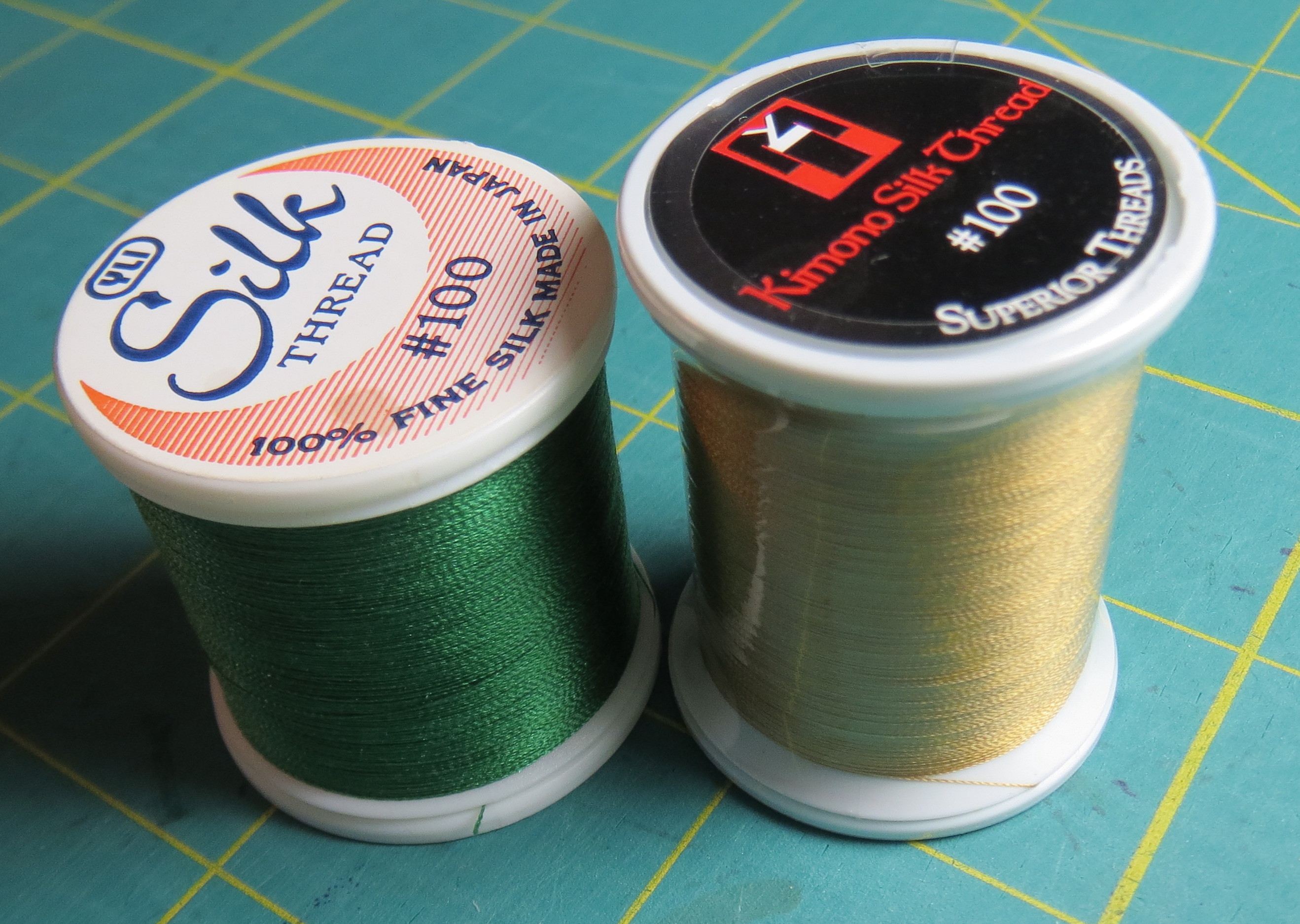
I am still working on my Japanese Kamon (family crest) blocks.  Right now I am stitching around the edges of the fused applique pieces – since I never trust the fusible to be permanent.  For these pieces, I want the stitching to blend into the fabric as much as possible.  I use size 100 silk thread for this purpose, since it is very fine.  I use silk thread made by YLI and also by Superior Threads.  Your local quilt shop may carry this thread for use in hand applique, or you may have to buy it on line.  The YLI version can be purchased through Amazon (like almost anything else you could want!) at this link:  Silk Thread 100 Weight 200 Meters-
Polyester size 100 thread is also available, but I prefer the silk.  The photo below shows a couple of spools of this thread.  Note the number 100 on the top of each spool.

YLI and Superior make size 100 silk threads, good for applique and machine quilting

YLI and Superior make size 100 silk threads, good for applique and machine quilting

I iron a piece of Totally Stable (by Sulky) on the back of my block.  Totally Stable irons on like freezer paper, but is tearaway so it can be removed reasonably easily.  Other stabilizers or even newsprint could be used but would have to be pinned in place.  You may also just use starch or sizing on the back of the block to stiffen it up; for the blanket stitching I am using here, that would probably be enough to keep the fabric from puckering.  I may try that on a couple of blocks and see if I can recommend it, since it would eliminate the tearaway step.  But today I am using the Totally Stable.  Incidentally, Totally Stable comes in various sizes – 8 1/2 by 11 sheets, 8, 12, or 20 inch wide rolls, etc.  I think the 12 inch wide roll is probably the most convenient for most quilters, and you can buy it at your local quilting/craft store or here at Amazon: Sulky 12-Inch by 12-Yard Totally Stable Iron-On Tear-Away Stabilizer Roll

After the Totally Stable is in place, thread your machine with size 100 silk in both the top and bobbin.  Check the tension – I like a setting of about 2 for my Bernina, but your machine may be different.  The bobbin thread should not show on the top if the tension is correct.

I set the stitch length to 1.5 and the stitch width to about 0.7.  I am using the built in blanket stitch (stitch 329 on my Bernina 180).  I like a pretty narrow stitch so it doesn’t show much.  The resulting stitch shows below on the lower leaf of this block; the other leaf hasn’t been stitched yet.  In this closeup view you can see the stitching.  From a little further away, it is nearly invisible.

Lower leaf has been machine stitch appliqued (blanket stitch with silk thread)

Lower leaf has been machine stitch appliqued (blanket stitch with silk thread)

I think this method is a good compromise.  The stitching is inconspicuous and it is fairly fast, so I will make reasonable progress.  If I try a block without the Totally Stable, I will report here how that went.