Category Archives: Art Quilts

Machine Applique with Silk Thread – Update

In the last post I mentioned that I was going to try spray starching my block instead of using a tear away stabilizer on the back.  I did try that, and it worked beautifully.  So no more stabilizer!  That saves a tedious step in the process.  I would still want to use the stabilizer if I were doing a satin stitch, but for the blanket stitch it is not necessary.  After starching all the light squares for my quilt, I finished the stitching on all the applique.  For these blocks, I had spray starched the applique fabric (on the front, to avoid affecting the fusing process) and thus had a minimal amount of fraying around the pieces.

I am now working on the dark blocks.  In my rush to make the blocks, I managed to forget about starching the applique fabrics ahead of time.  My first machine stitching resulted in a lot of fraying and I was not happy with the result.  So the next thing I tried was to spray starch the whole block, front and back.  This avoided the need for the stabilizer and also resulted in a much cleaner look to the applique on the front, as you can see by comparing the two photos below.

Applique fabric not starched

Applique fabric not starched

Entire block starched front and back before stitching


I think there is going to be a lot more spray starch in my future.  Before committing to it I will have to rinse out a couple of blocks and make sure the fraying doesn’t happen later, but so far I am pleased with the results.  This is a much faster way to get a good result.  Of course if you do this be careful about breathing the fumes!

Completion of “Negative Space” quilts

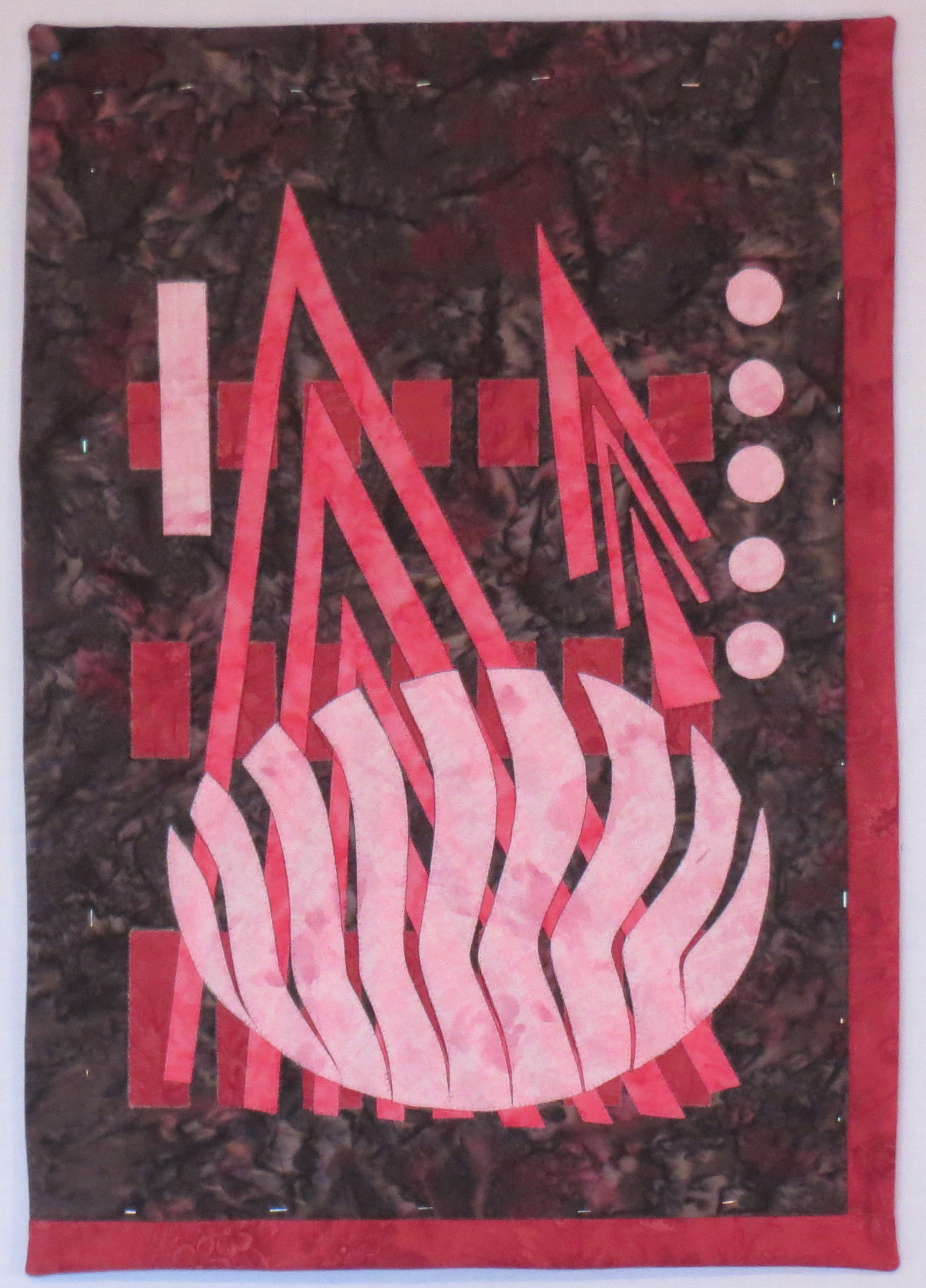
Last spring I took an online art quilt class at Quilt University from Marilyn Belford  (www.marilynbelford.com) .  I posted photos of some of my class homework at the time.  I have finally completed several of these class projects and am including photos here.  All of these projects were done on fusible web.   As a reminder, each project started with a large shape such as a circle, triangle, or rectangle being cut out of one fabric (with fusible web attached).  Then that large shape was fractured into a bunch of smaller shapes, which were then “stretched out” on top of a second fabric and fused down.   For the later exercises, shapes were cut from more than one fabric.

I did a lot of these exercises in the class and I still have three more to finish.  In all cases, the little quilts were completely finished from my fabric stash.   For the finished projects shown here, most of the pieces were machine appliqued using a fine thread and a small blanket stitch.

And now the quilts.  This first one has “fractured” triangles and other assorted shapes:

Multicolor geometric shapes

Multicolor geometric shapes

And the next one has a fractured circle and fractured triangles:

Circles and Triangles

Circles and Triangles

And now one where the assignment was to think of a feeling and express it using simple shapes.  The feeling I used was feeling “unbalanced”:

Unbalanced

Unbalanced

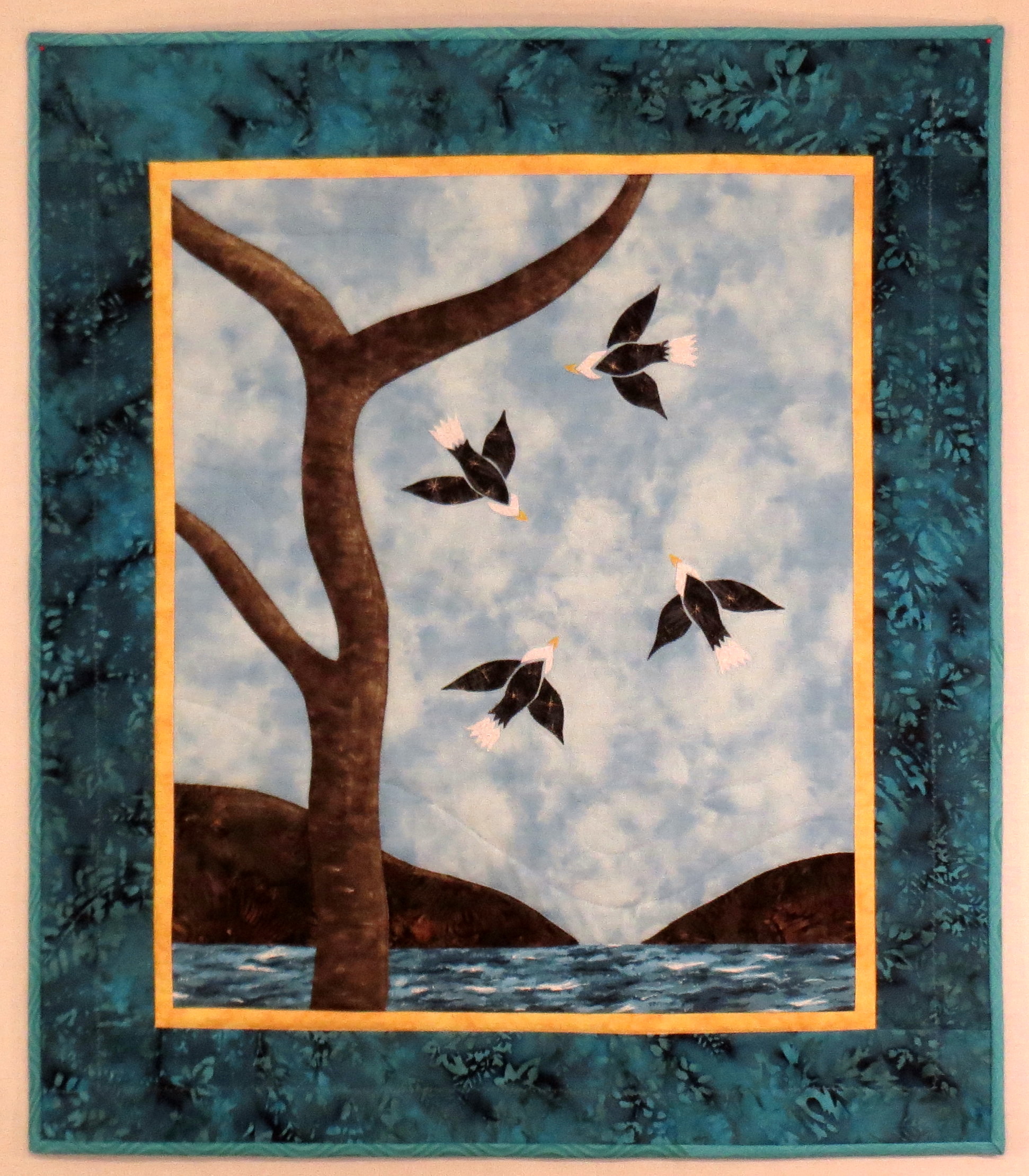
And the last one was an experiment (I don’t think this was actually a class assignment, but I could be wrong) where I decided to try simplifying an animal shape while retaining the “essence” of the animal so that it would be recognizable.  I used bald eagles because they are so recognizable and also because they roost in our trees here and we often see them performing acrobatics in the sky.

Acrobatic eagles

Acrobatic eagles

I used a gold metallic Shiva Paintstik to add some dimension and shading to the tree.  It worked fairly well considering my lack of painting experience.  The one negative is I can still smell the paint on the quilt — but then it has only been two days, so perhaps it will go away with time.

I really like these little abstract quilts.  The question is, what do I do with them now?  I don’t believe they are very marketable.  My cousin, who is an abstract painter, tells me that abstract art is a tough sell:  90 % of all people aren’t much interested in art; of the remaining 10 % who do like art, 90 % aren’t interested in abstract art.  So selling a good landscape painting (or quilt) is going to be a lot easier than selling abstract art quilts.  Good thing I don’t have to make a living with my quilts!


Caryl Bryer Fallert-Gentry

We local quilters up here on the Olympic Peninsula are very pleased that Caryl Bryer Fallert (now Gentry) is joining us at least part time due to having married a local man.  She treated us to a reception and exhibition of some of her quilts last week at the Port Townsend Yacht Club.  She has a special exhibit in Houston next month, celebrating 30 years of quilting, and these quilts will be part of that exhibit.  She used her line of Benertex fabrics for the quilts, and the use of ombre or gradated fabrics is great and I plan to purchase some of them and see what I can do with them.  Of course her use of color was, as always, outstanding.  And the only word for her free motion quilting, all done with a home sewing machine,  is exquisite.  She really sets the standard for quality and gives the rest of us motivation to improve our own skills.  You can find out more about her art at her website, www.bryerpatch.com .

Ink-li-que project

Last week I experimented with Ink-li-que, which is a technique where the quilt is first quilted and then colored with ink.  There are a number of quilt artists who have carried this technique further and are using all kinds of paints to paint their quilts rather than use piecing or applique techniques.  At the end of this post I will give you a couple of references where you can get further information if it is of interest to you.

At least one major quilt show (Road to California) has recognized the need for a new competition category, and has added a category called “Painted Surface” to reflect this type of work and yet keep it separate from traditional quilting techniques.  In my opinion this is an important distinction and I hope all quilt shows will adopt this new category.

Now back to my modest attempt at Ink-li-que.  As you can see in my gallery, I recently started experimenting with Zentangle drawings and enjoyed that process.  Susan, a member of my guild, pointed out an article by Sherry Rogers-Harrison on Ink-li-que in American Quilter magazine from a couple of years ago.  She commented that it looked like my zentangle work.  I decided she was right and I should explore Ink-li-que a little to see if there were some different techniques I could apply to future zentangle quilts.

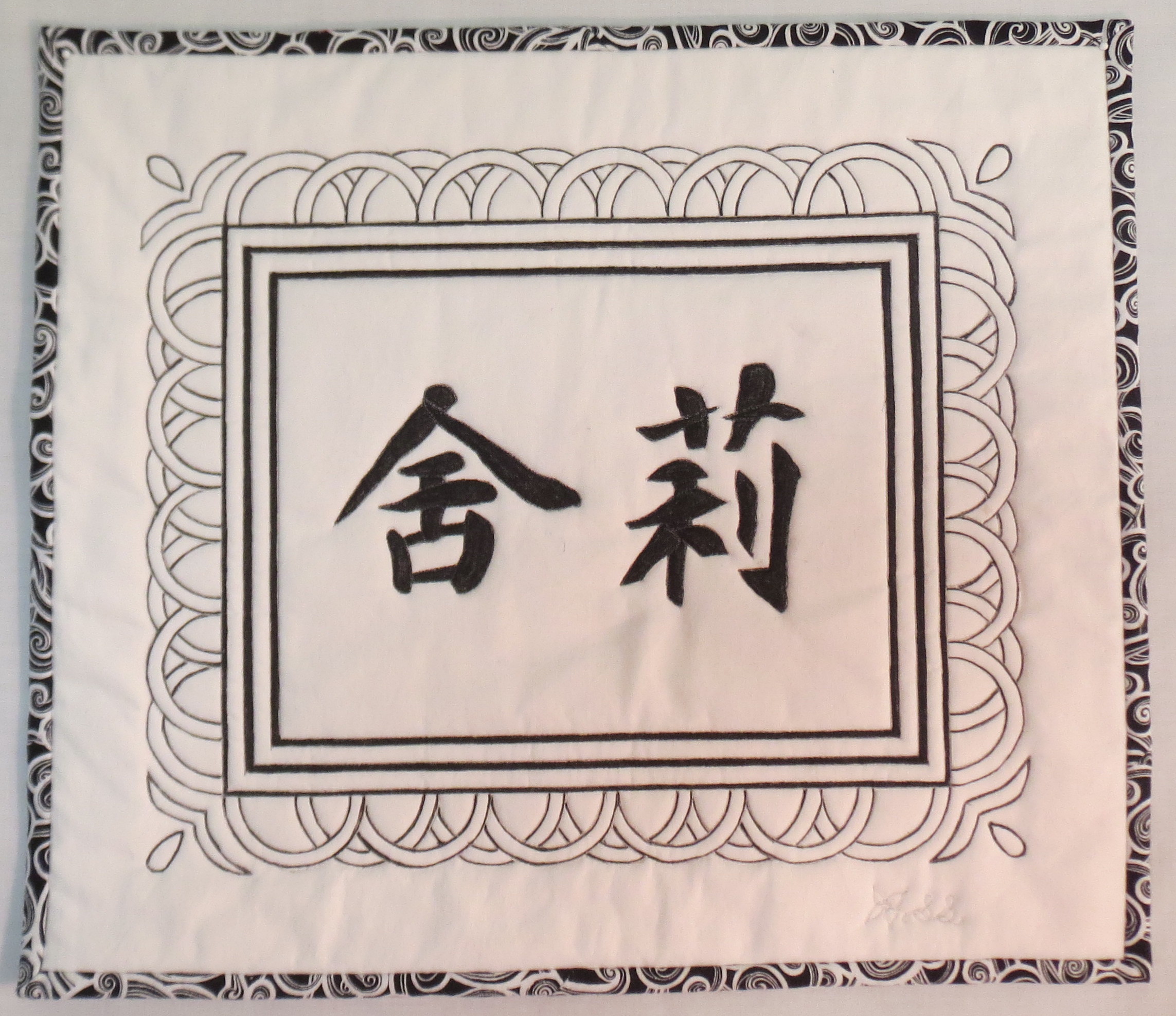
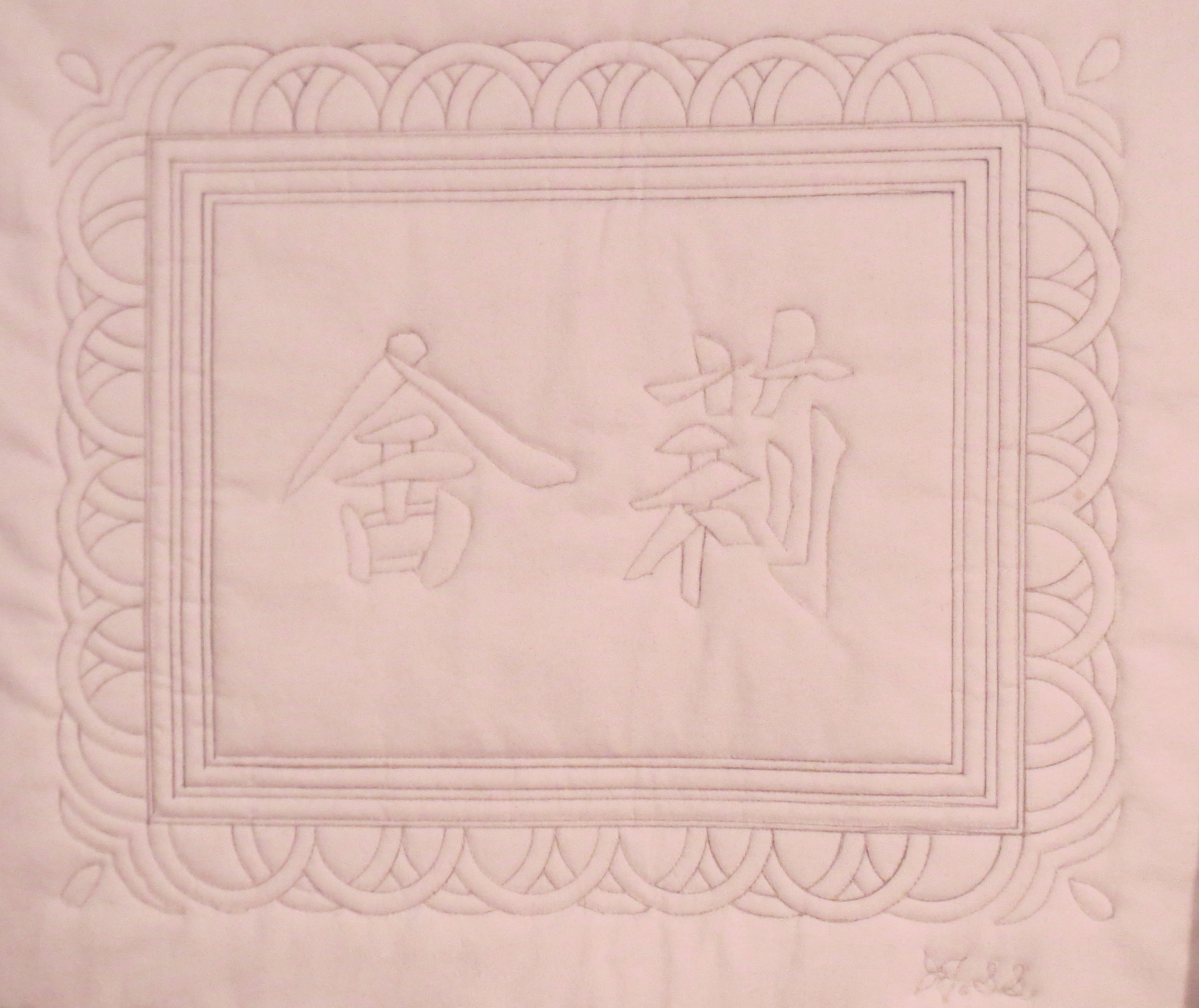
I designed a small quilt in black and white (the central chinese characters came from a book on Chinese calligraphy and are supposed to represent “Shirley”) .  Following Sherry’s directions, I used a high thread count fabric (Pimatex) and pre treated it by spraying with Scotchgard and an art fixative.  After letting the fabric dry – it was quite stiff – I drew the design on the fabric with a pencil.  I sandwiched the quilt and stitched on the drawn lines with a fine white thread.  I did some free motion but a lot of the stitching was done with a walking foot, since I knew the straight lines would come out straighter that way.  Then I used a Gelly Roll pen to draw on top of the quilting threads, and used Pigma pens to fill in the large black areas.  You can see the quilted but not inked version below with the inked version underneath.

My Chinese name, not yet inked

My Chinese name, not yet inked

My Chinese name inked

My Chinese name inked

Although this came out OK, I think I would prefer it done more traditionally – using a heavy black thread and/or satin stitching for the lines, and with the characters done in regular applique.  There is a flatness to the ink that doesn’t appeal to me for this formal a design.  Interesting, since I don’t have the same reaction to the zentangle form, which I like a lot.

There are many quilt artists who have carried this form to astonishing lengths and achieved beautiful results.  Sherry Rogers-Harrison has some beautiful quilts at her website, www.sewfarsewgood.org . She also has made some you tube videos showing the techniques.  Leah Day, another talented quilter, also has videos showing similar techniques.  You can see these through her website, www.DayStyleDesigns.com  .  Or just do a search for either Sherry or Leah on youtube or with your favorite search engine.  With use of rich metallic paints and clever highlighting, they can really make a quilt glow.

Pacific West Quilt Show 2013

Last week I volunteered at the Pacific West Quilt Show for the first time.  I would encourage all of you to volunteer at a major quilt show at least once.  I certainly appreciated the show more for having seen the effort involved.  Many of our well known local quilt instructors and authors were in attendance.  I  was impressed that these ladies, so busy  teaching classes, writing books, etc., would contribute so much time to the show.

I helped hang the quilts in the main exhibition hall on Thursday. Heidi Lund  was in charge of the quilt hanging and maintained amazing calm considering the chaos.  I took a wonderful class from Heidi a few years ago.  She is a real master with thread, and some of you may have seen her spectacular garments in wearable art shows.  In the morning I worked with Maggie Ball (www.dragonflyquilts.com   ) and another quilter named Val whose last name I didn’t learn.  They were a pleasure to work with and had hung the quilts before, so we made lots of progress.  Seeing the quilts up close and personal during the hanging (especially the backs of the quilts, mostly not visible during the actual show) helped us appreciate the incredible skills of the quilt makers.

On Friday morning I was at the volunteer desk, checking in the many volunteers working the show.  Susan Purney-Mark was in charge and did a great job directing the volunteers and solving the many small problems that came up.  Susan had taught a class the day before and said she volunteers for the duration of the show every year.  In the few quiet moments, she graciously offered advice about book publishing, blogs, etc.  I really enjoyed our conversation.  Check out Susan’s website,  ( http://www.susanpm.com  )  and her blog (www.susanpm.blogspot.com ) for some really interesting info on fabric painting, stenciling, coming up with original quilt designs, etc.

I am not sure if there are restrictions about publishing photos of other quilters work here, so I will include a couple of photos of my quilts hanging in the show and no others.  There were as usual many spectacular quilts.  I am always astounded by the amazing skill and patience shown by the makers of the winning quilts.  I expect there will be photos of the winning quilts available online fairly soon.

Fireballs Quilt at the Pacific West Quilt Show 2013

Fireballs Quilt at the Pacific West Quilt Show 2013

Leaves In The Wind at PWQS
Leaves In The Wind at the Pacific West Quilt Show 2013

My quilts from the show arrived back at my house on Tuesday about noon, so the quilt return process was conducted with the same efficiency as the rest of the show.  The judge’s comments on my quilts were included with the returned quilts and were both encouraging and helpful.  Congratulations to show director Elizabeth Spannring (www.plaidcat.com) and the rest of the team for all their great work!

New art quilts

I have finished a couple of little quilts I started in the art quilting class I took from Marilyn Belford last spring.  The first is a still life made using the Broderie Perse technique.  The background is a commerically made gradated fabric for the lower part and a light mottled print for the top. A lighter gradated fabric was used for the pear.

A fusible web was placed on the back of a rose floral print and the individual flowers cut out.  Leaves were cut from a green fabric, and a vase shape made from the black.  Then the pieces were arranged in a pleasing manner and fused down.   This process is fun and relaxed, since the pieces can be rearranged at will before fusing.  After fusing, the pieces were sewn down using free motion. A stabilizer was used on the back to keep the top from puckering during this stitching process.

Coordinating borders were added and the whole thing quilted. Walking foot quilting was used for the straight lines and free motion for the rest.

A rose floral arrangement made using the Broderie Perse technique.

A rose floral arrangement made using the Broderie Perse technique.

The second quilt is one that was a series of exercises in use of “negative space”.  Fusible web was placed on the back of a rectangle of green.  It was then cut up into smaller shapes, mostly rectangles.  The pieces were spread out on top of a blue print to leave gaps between.  I had to add a few additional small pieces to “fill in” the whole rectangle.  The pieces were fused down and stitched around the edges with a decorative stitch.

I then added the green border and did the binding in the blue print.  I wanted the binding to be a design element, so I cut 3 inch wide strips and sewed the binding on with a 7/16 inch seam allowance.  This results in a nice wide binding and the corners really miter into nice sharp points!  The rectangle and borders are done slightly asymmetrically – partly due to the placement of the cut up rectangle on the original piece of blue print.   I think it would have been better if I had either kept it all symmetric (cutting off some of the lower blue print) or made it more asymmetric, so that it looked more deliberate.  The quilting was all done with a walking foot.

A cut up rectangle demonstrates the use of negative space in a quilt design.

A cut up rectangle demonstrates the use of negative space in a quilt design.


Pacific West Quilt Show August 23-25

As I previously announced, three of my quilts will be in the upcoming Pacific West Quilt Show.  The show management sent me a draft press release, which I modified slightly and sent to the local paper along with a photo of my quilt, “Fireballs”.  All three of my show quilts are shown on my gallery page, so you can see them there.

PRESS RELEASE

FOR IMMEDIATE RELEASE Contact: Elizabeth Spannring – 360.635.6500

Local Resident  Finalist in Regional Quilt Competition

Shirley Sandoz from Nordland, WA is a double finalist in the Pacific West Quilt Show to be presented August 23-25, 2013, at the Greater Tacoma Convention & Trade Center, Tacoma, Washington. Her two  pieces titled “Leaves In The Wind” and “Fireballs” will compete with 191 quilts entries from the 18 US states and Canadian provinces of the Pacific West region: Alaska, Alberta, Arizona, British Columbia, California, Colorado, Hawaii, Idaho, Montana, Nevada, New Mexico, The Northwest Territories, Oregon, Saskatchewan, Utah, Washington, Wyoming, and Yukon. Over $25,000 in cash and prizes will be awarded to winners in nine categories. The producing organization of this contest, the Association of Pacific West Quilters (APWQ), a non-profit organization, was founded in 1992. APWQ is dedicated to promoting the art of quiltmaking throughout the Western US and Canada.

In addition to her two entries into the juried show, Shirley Sandoz also has another quilt, “Tropical Flowers and Sashiko” that will be part of a special exhibit of floral quilts by members of APWQ.

Pacific West Quilt Show attendees will be inspired and awed by the beauty, depth, and diversity of the finest quilts being produced in the region. In addition to the competition quilts featured at this world-class quilt show there will be special quilt exhibits, workshops, special events and shopping in the fabulous Merchant Mall.

The Pacific West Quilt Show is open to the public from 10:00 am to 6:00 pm Friday and Saturday, and 10:00 am to 4:00 pm on Sunday. For more information about the 2013 Pacific West Quilt show, please visit www.apwq.org.

Trunk Show and “Meet the Author” event August 7

As previously announced, I am doing a book signing/trunk show/demonstration event next week at Silverdale Quality Sewing and Vacuum.  This is a first time for me so I have spent a lot of time in the last few weeks gathering quilts, getting organized, etc.  This week the store put out a very nice promotional email, which I have reproduced below.  Contact the store directly via their website (www.QualitySewing.com)  or phone (360-692-2992) to sign up for the show.

Trunk Show and Signing Event Coming to Silverdale!

Would you like to learn how to free-motion quilt? How about doing a Prairie Point binding?
Come meet Shirley Sandoz, local author, quilt designer, and educator. Author of “Fast Fabulous Bindings” and “Super Swift Quilts,” plus numerous quilt design patterns.

We are fortunate to have Shirley in our Silverdale store August 7th to sign her book and give a demonstration, along with bringing a trunk show full of all her fabulous quilt designs.
Sign up early and receive a $5 shopping spree to use the day of the show.

Shirley Sandoz: Trunk Show & Signing Event Silverdale: Wednesday, 8/7, 10:00 AM to 1:00 PM

Quilt Stick Quiver

Well, most of you probably don’t need one of these, but I did so I am going to describe how I made it.

First, why would you need one?  I make a lot of art quilts.  They have to be hung on the wall.  In an earlier post, I described how to make simple quilt hanging sticks.  Charlie Petersen and I have now had two shows of our quilts at the Uptown Dental Clinic in Port Townsend.  This last time we hung about 40 quilts.  That requires a lot of sticks – at least one per quilt.  For my big quilts, I put a hanging sleeve at the bottom of the quilts also and insert a stick there.  The quilts look so much better when the bottom edge isn’t waving around all over the place.  (They look better when the sides don’t wave either.   Guess you could put pockets on the sides (like a hanging sleeve, but with the bottom end closed) and use sticks there too; I haven’t ever gone that far).  Charlie and I just stick the sides down where needed with blue painter’s tape hidden underneath and call it good.

So back to the quiver.   After we took down the show last week, Charlie and I were struggling with all those sticks.  I decided to make a couple of quivers (one short, one long) to hold the sticks both for storage at home and for easy transport to a show.  I bought some upholstery fabric for the outside, a coordinating fabric for the lining, and some stiff fusible interfacing (what you would use for any bag where you wanted the sides to stand up).

Cutting instructions.  The quiver fabric needs to be about 16 inches wide.  The length can vary.  I made two, one 24 inches long for short sticks, and one 40 inches long for long sticks.  Cut a rectangle of the outer quiver fabric 16 inches by the desired length, and a rectangle of the lining fabric the same width and 4 inches longer that the outer fabric.  Also cut a long strip (4 inches wide by 20-35 inches long, depending upon the length of your quiver) of the outer fabric for the strap.  And cut a rectangle of the fusible interfacing one inch smaller in each dimension than the outer fabric (for example, outer fabric 16 by 24 inches; interfacing 15 by 23 inches).

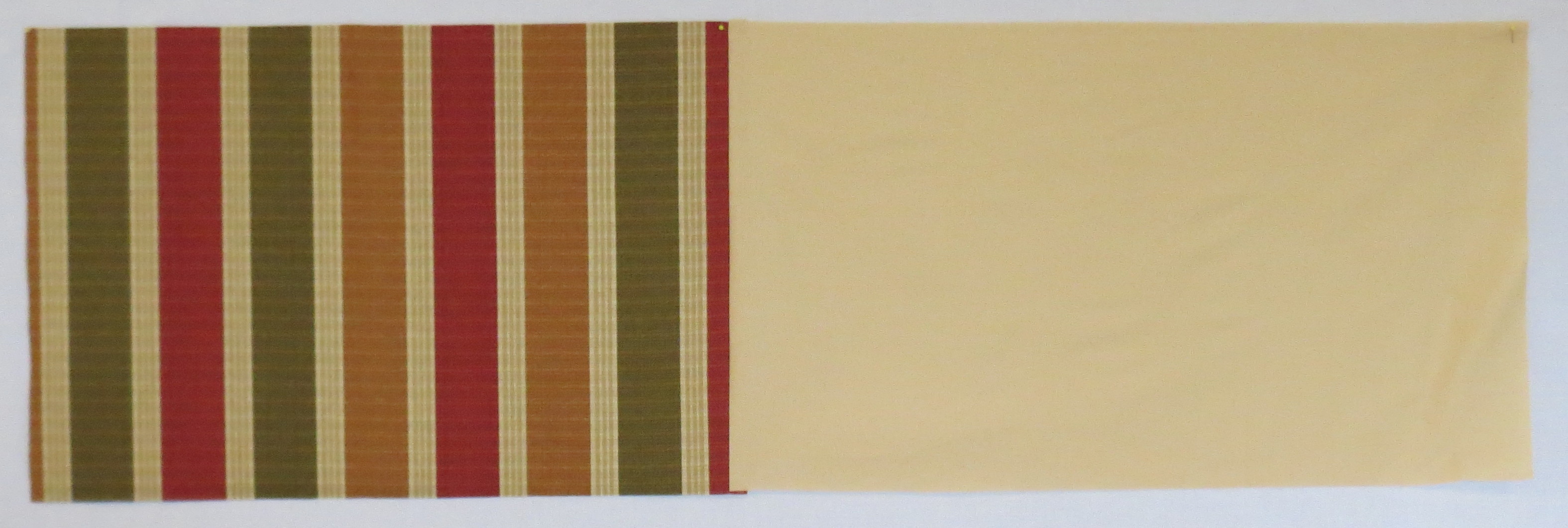
Fuse the interfacing to the wrong side of the outer fabric, leaving a half inch of fabric exposed all around.  The photo below shows the outer fabric with interfacing, and the lining fabric.
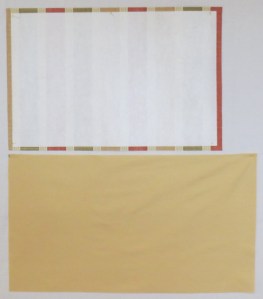
Outer fabric rectangle with interfacing and lining rectangle

Outer fabric rectangle with interfacing and lining rectangle

Make the strap by pressing a ½ inch hem on each long side toward the wrong side of fabric as shown below.
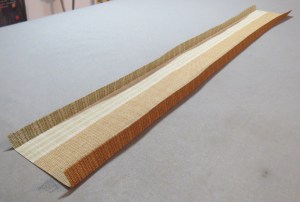
Fold and press 1/2 inch hem on each side of strap

Fold and press 1/2 inch hem on each side of strap

Then fold the entire strip in half lengthways with the side hems inside and the right side out. Sew along the open edge as shown below.  Don’t worry about finishing the ends, since they will be sewn into the seam of the quiver.
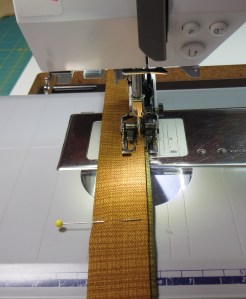
Fold the strap in half and stitch the open edge

Fold the strap in half and stitch the open edge

Sew the lining fabric to the outer fabric, right sides together end to end , with a ½ inch seam.  This will look as shown below.

Sew outer and lining pieces together end to end

Sew outer and lining pieces together end to end

Pin the strap to the quiver outer fabric along one edge.  The upper end of the strap should be about 3 inches from the outer fabric/lining joining seam. Make the strap perpendicular to the raw edge at the top and either perpendicular or at an angle at the other strap end about 12-20 inches lower.  Leave enough of a loop in the strap so it will be comfortable to sling over your shoulder for carrying.  You want the strap to be mostly in the upper half of the quiver.  Machine baste both ends of the strap in place.

Fold the quiver in half the long way, right sides together.  Because the fusible interfacing is so stiff, you will have to force a fold in it. Tuck the strap inside so it won’t get caught in the stitching. Sew the outer fabric end closed and sew the long edge closed, but leave the lining end open for turning as shown below.  Reinforce the seam over the straps with an extra line of stitching.

Fold in half and sew along the outer fabric narrow end and all along the long side.  Leave lining end open.

Fold in half and sew along the outer fabric narrow end and all along the long side. Leave lining end open.

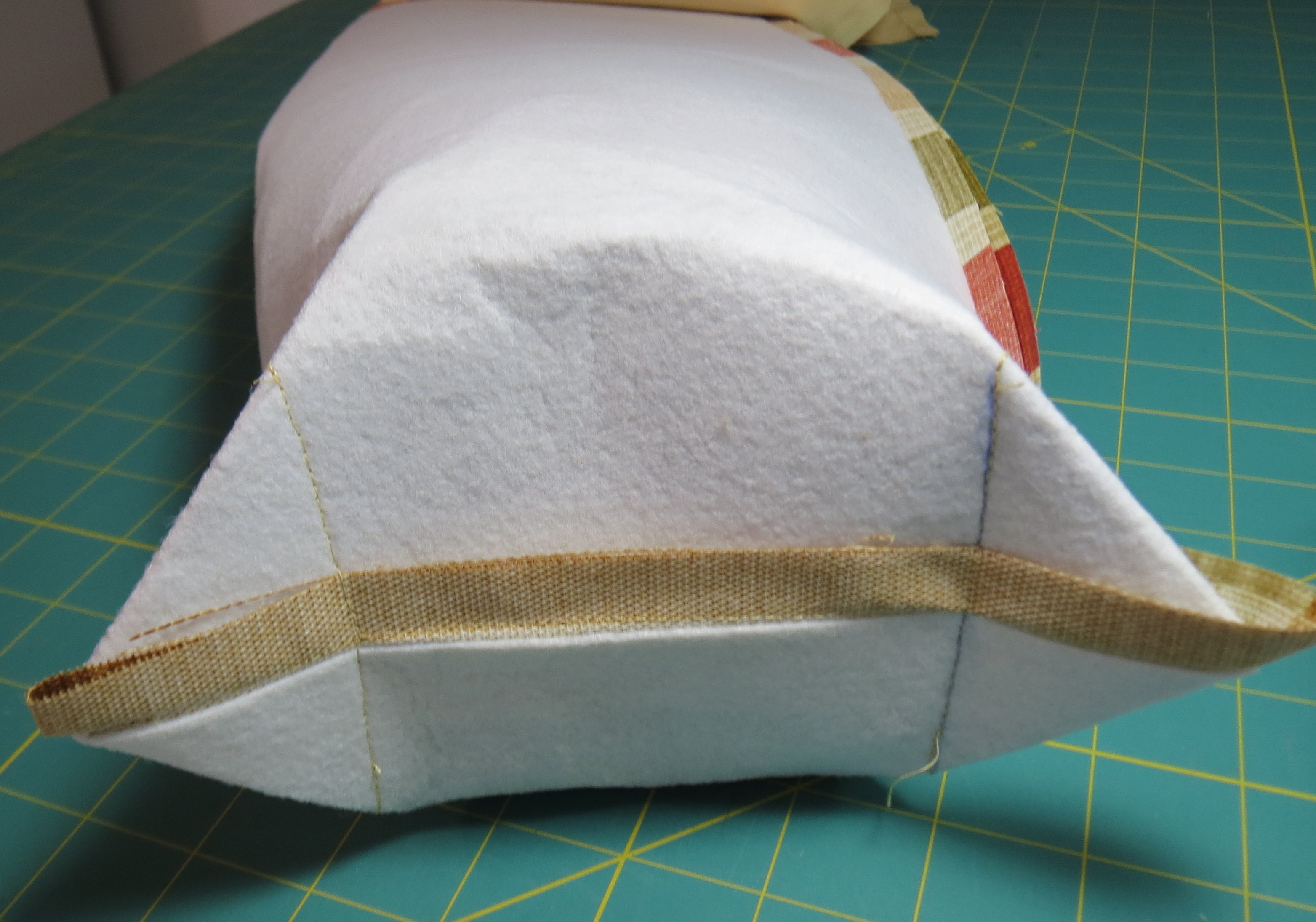
Open  the bottom out and sew across to make a couple of “ears” as shown below.  The seam to make each ear will be about 3 inches long, so the bag will be roughly circular at the bottom.

Round out the bottom of the quiver by sewing two "ears" as shown.

Round out the bottom of the quiver by sewing two “ears” as shown.

Turn the bag right side out through the opening in the lining.  This is a little tough because of the stiff interfacing.  I managed this with my 40 inch long quiver, but I wouldn’t want to try one much longer than that.  The shorter quiver was a lot easier to turn.  The right side out bag, with lining still outside, is shown below.

Quiver turned right side out

Quiver turned right side out

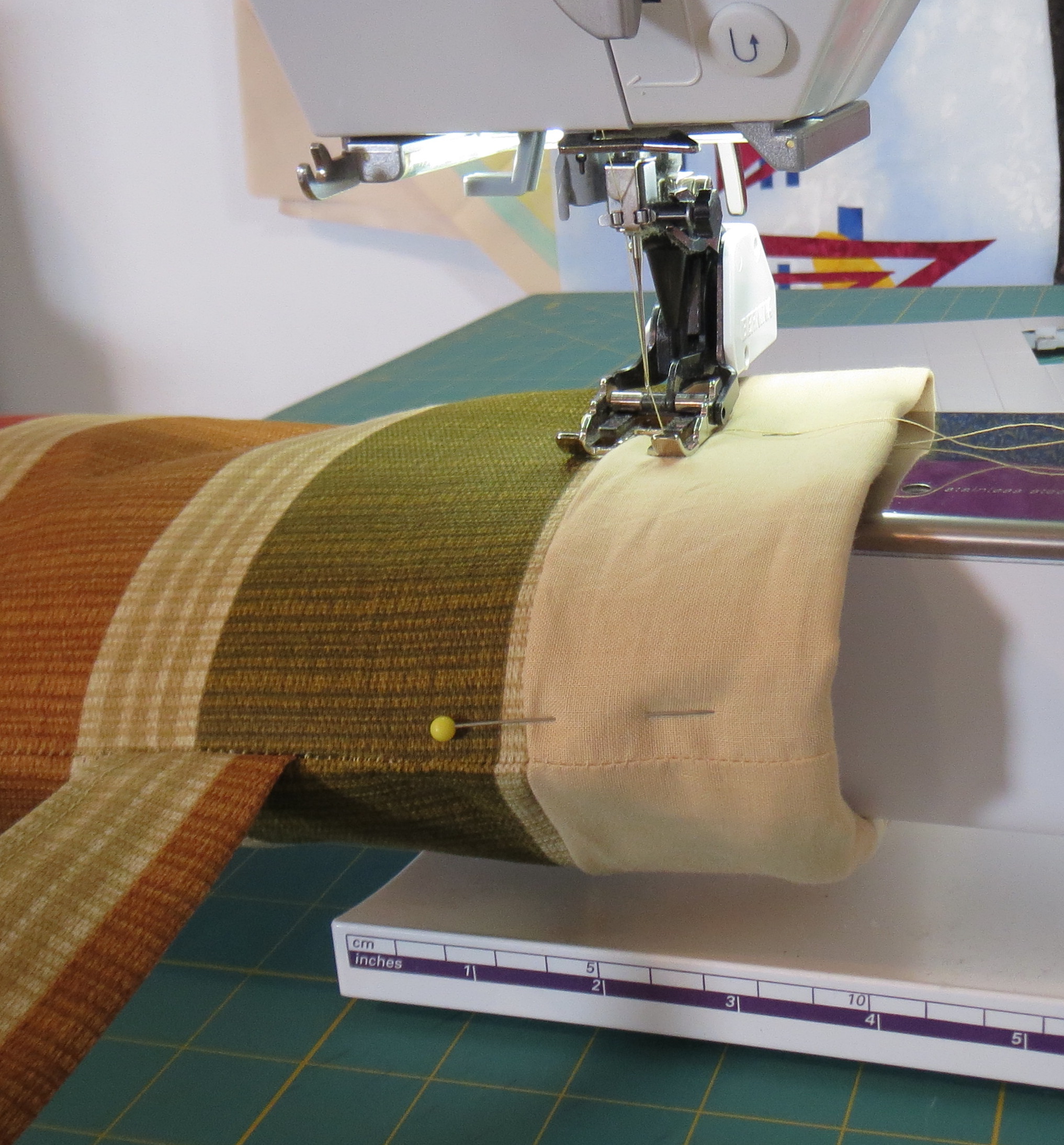
Fold under ½ inch of the raw edge at the end of the lining and sew across to close the opening.  Then push the lining down into the quiver.  Use a stick or round rod to get it to the bottom.  Roll the excess lining length over the top of the quiver to form a cuff.  Sew down the edge of the cuff as shown below.

Quiver top cuff seam

Quiver top cuff seam

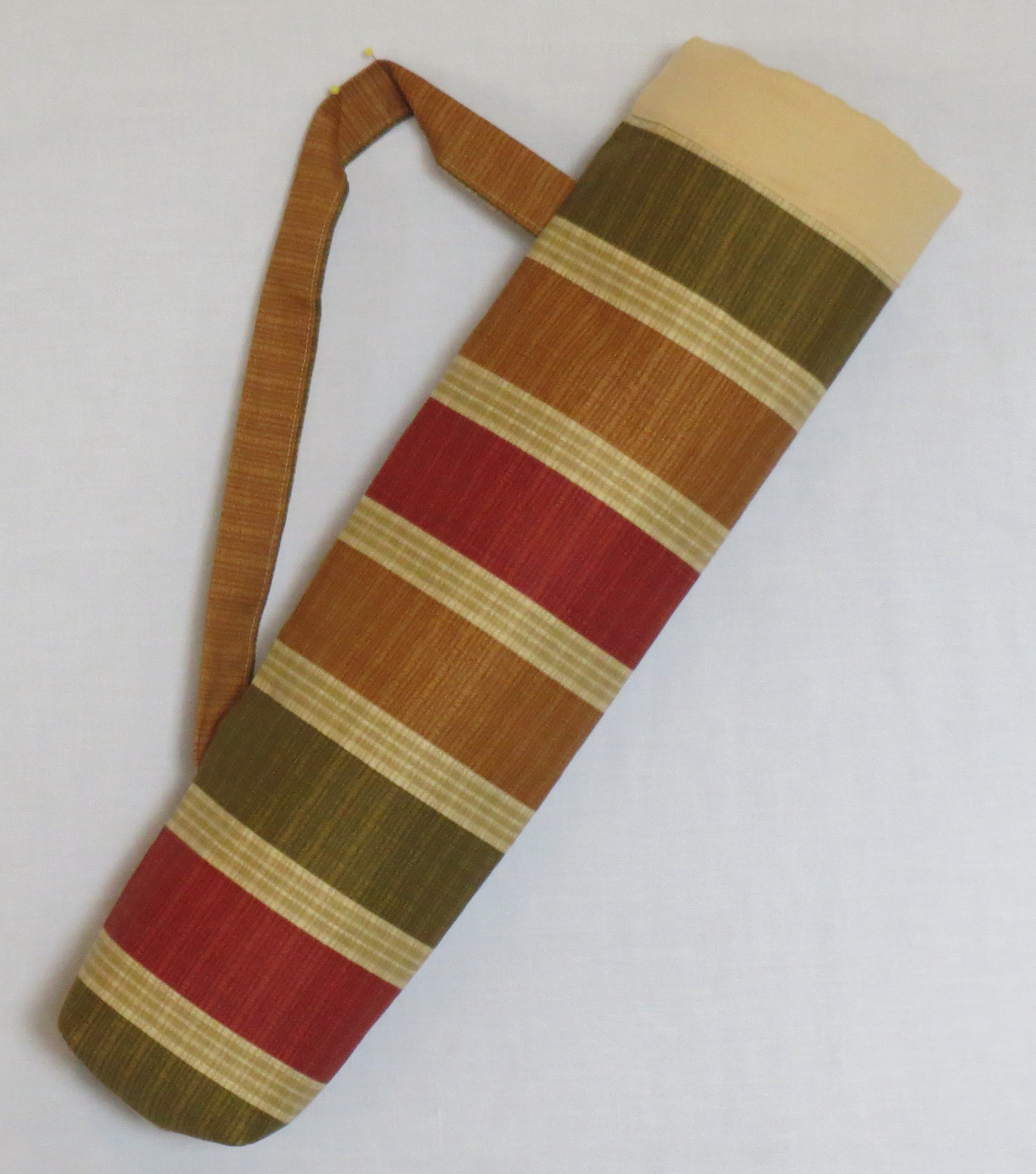
Your quiver is complete:

A completed quilt stick quiver

A completed quilt stick quiver
Tropical Flowers and Sashiko will be in the Pacific West Quilt Show

I was just notified that my quilt “Tropical Flowers and Sashiko” wll be included in a special member’s exhibit at the Pacific West Quilt Show in Tacoma August 23-25, 2013.  All the quilts in the exhibit have a floral theme.  It is one of three special member’s exhibits in the lower exhibit hall, separate from the juried show upstairs.  This quilt is made from a pattern by Sylvia Pippen and was a joy to make.

Those of you who have attended the PW show in the past know that the numerous special exhibits in the lower hall are wonderful.  I always enjoy that part of the show, so when the opportunity to participate came up last month, I quickly sent in an application and photos of my quilt.  You can see a photo of the quilt on my gallery page — it’s the last quilt shown.

As I posted earlier, my quilts “Fireballs” and “Leaves In The Wind” were accepted into the juried show, so they will be in the upstairs exhibit hall.

Hope to see you at the show!