Hanging Your Quilts – Quick and Easy

Last Friday my friend Charlie and I hung nearly 40 quilts in about 4 hours, with help from Charlie’s friend Susan. Today I am describing the materials we used to hang our quilts without spending too much time or money.
1. For little quilts ( up to about 15 inches wide) or for special applications such as hanging a larger quilt on a curved wall, one option is to use rings. Small curtain rings, rings intended for construction of roman shades, or split rings that are sold near the keys in your local hardware store will work. Just find smooth rings about ½ to ¾ inch in diameter, sew them to the top back of your quilt about 5/8 to 1 inch below the top. Using a needle and strong thread, go around the ring and through the back of the quilt and batting only. Go around several times so the connection is strong enough to support the weight of the quilt. Add more rings along the top of the quilt as needed until the top edge of the quilt doesn’t sag.
These rings will hang from 1 ½ inch long finish nails that you pound into the wall leaving about 3/8 inch of the nail protruding out.
2. For medium size quilts (up to about 40 inches wide) use a hanging sleeve and stick at the top of the quilt. For large size quilts (48 inches or wider), the quilt will hang better if you use hanging sleeves and sticks at both top and bottom.
3. For a good description of how to make a hanging sleeve, go to http://moonlightingquilts.wordpress.com/2012/04/05/in-defense-of-the-proper-quilt-sleeve-and-how-to-make-it-in-6-easy-steps/. Make the sleeves at least 4 inches narrower than the width of your quilt. (NOTE:  For hanging on rods or poles at a quilt competition, you may want to make the sleeves nearly the same width as your quilt.  But for use of sticks as described here, you need clearance for the end of the stick and the holes for the nails).
4. Purchase the sticks at your local lumber yard or home improvement center. Go to the moulding (or molding, spelling is not consistent) department and ask for unfinished hemlock moulding. Other woods will also work, but hemlock is the most commonly available in the U.S. The kind you want is called either screen mould (approx 3/16 inch thick by ¾ inch wide by 8 feet long) or door stop (approx 5/16 inch thick by 1 3/16 inch wide by 8 feet long, or 7/16 inch thick by 1 3/8 inch wide by 8 feet long).
The screen mould size should be sufficient for small and medium sized quilts. Use the door stop mould for the top of larger quilts. Screen mould works for the bottom of large quilts. If you cannot find the door stop mould, you can substitute lattice which comes ¼ inch thick by 1 1/8 inch wide by 8 feet and also in larger sizes. The disadvantage of the lattice is that the corners are not rounded, so you are more likely to get slivers in yourself or your quilt unless you sand down the corners carefully.
5. Measure the width of your quilt and cut the stick about 1 ½ inches shorter than the quilt width.
6. Mark a location about ½ inch in from each end in the center. Drill a 1/8 inch diameter hole at each mark. The diameter is not critical, it just needs to let the nail pass through easily. Remember that you need some flexibility in the hole size in case your nails go into the wall a little crooked.

Quilt stick drawing Apr 16 2013
7. Now you should have a finished top stick with two holes near the ends.
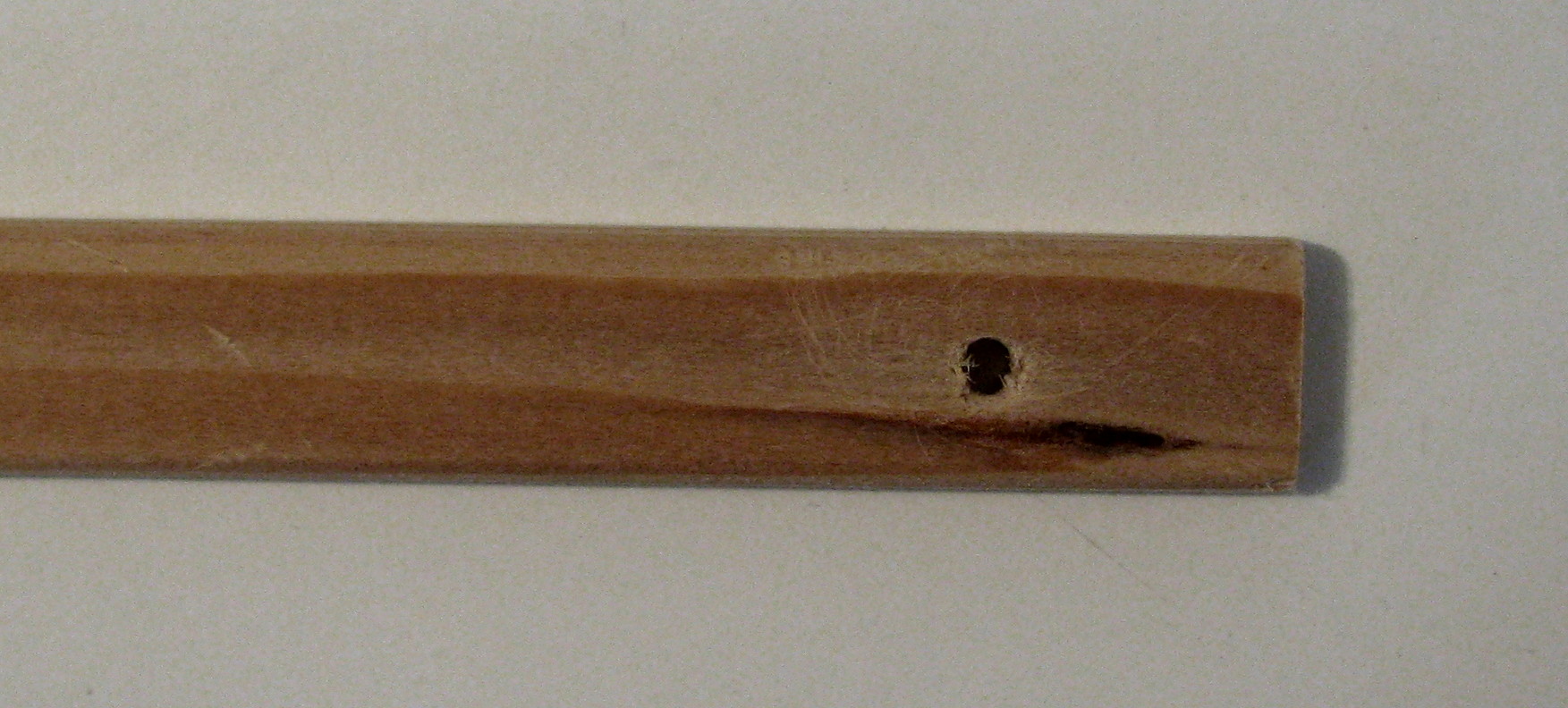
quilt hanging stick end with hole Apr 16 2013

One end of the stick will look like this photo. Break off any little bits of wood around the hole and sand it if necessary.  The  sticks for the quilt bottom look the same but don’t need any holes at the end.
8. Pound one of the nails into the wall at the height you like. Hang the stick on the nail from one end through the hole. Hold the stick out horizontally by measuring down from the ceiling or use a level. With a pencil, mark the location of the second hole. Put a nail at the mark. Test the stick to ensure the holes slip smoothly over both nails.
9. Remove the stick from the nails, slip it into the top hanging sleeve of your quilt, and hang the quilt and stick back on the nails.  Smooth the top edge  of the quilt.  If you are hanging a large quilt, now is the time to insert the stick in the bottom sleeve.

10. Stand back and admire your quilt!

© 2013 by Shirley Sandoz and Mystery Bay Quilt Design.  All rights reserved.


Quilt Show in Port Townsend

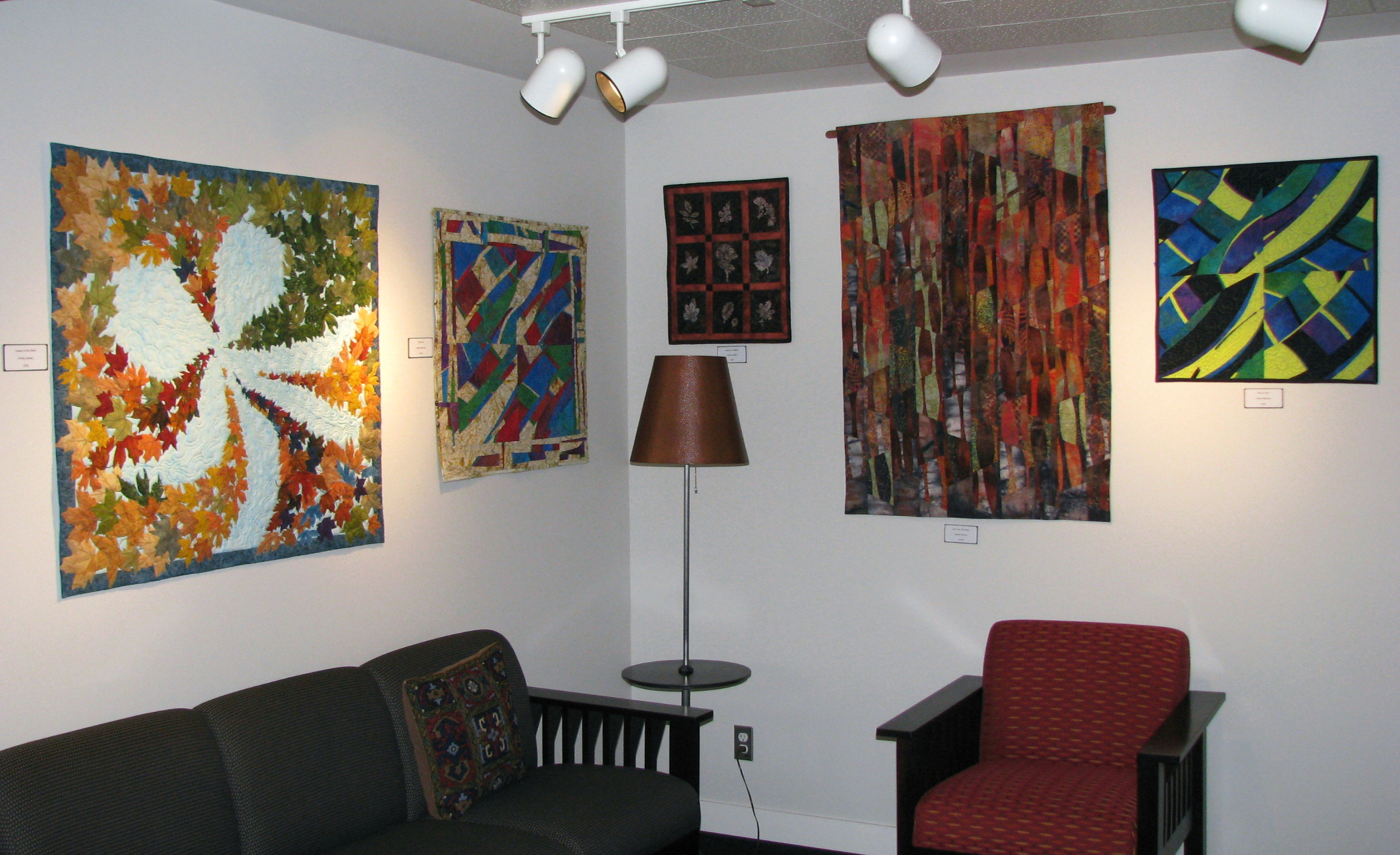
Yesterday my friend Charlie Petersen and I hung more than 35 of our quilts at the Uptown Dental Clinic in Port Townsend, Washington. The quilts will be on exhibit from April 15 to July 11 this year. If you are in the area, do come to the show.  Details are under the Calendar page.

Here are three photos after we hung the show. The lighting isn’t quite right yet — the Clinic staff will adjust the lighting next week, now that the quilts are hung. But I took these photos today as we finished putting up the quilts.

The waiting room seating area

Uptown Dental reception area aa and trim Apr 12 2013

The main hallway – quilts from one end to the other.  The Clinic staff loves all the color quilts add to their environment.  We love them for giving us the opportunity to take our quilts out and show them off!

Uptown Dental main hallway aa and trim Apr 12 2013

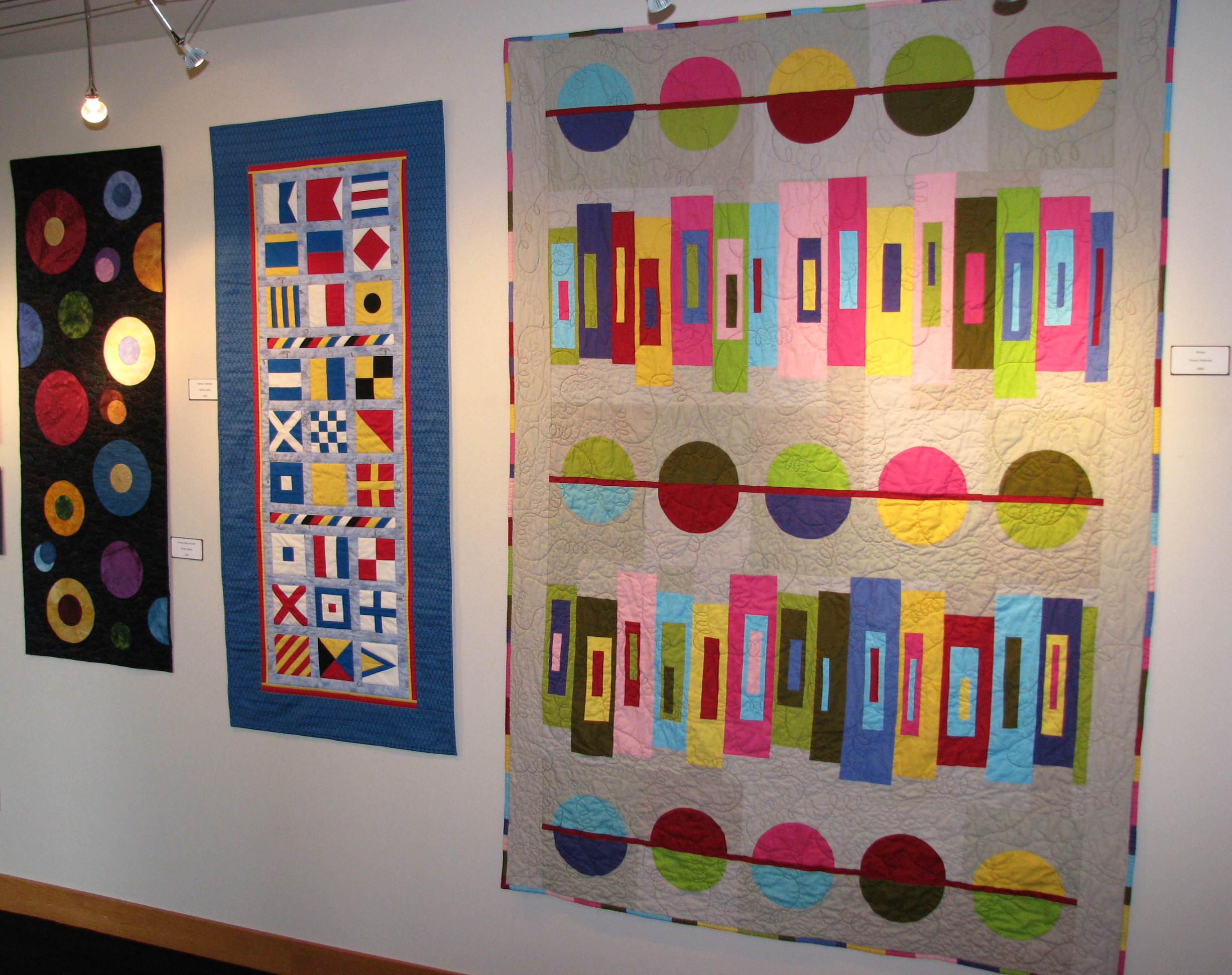
And a shot of one area in the hallway.  Charlie has been exploring modern quilting lately; the one on the right is one she finished a couple of months ago.

Uptown Dental main hallway colorful quilts aa and trim Apr 12 2013

© 2013 by Shirley Sandoz and Mystery Bay Quilt Design.  All rights reserved.

Making your quilt pictures better

As I have been building this blog, I used many photographs of my quilts. These photographs had been taken at different times with different lighting. The light in my quilting studio is pretty good, but is only really good for photography on sunny days. So there was a lot of variation in the quality of my photographs, and some have much better color accuracy than others.
For a good article about quilt photography, go to www.adventurequilter.com/e-Learning/Articles/Photography_Quilts.html . Before you worry about the details I am discussing here, you need to do the best you can to get a quality photograph. I am going to talk about what to do with that photograph, once you have it, to get the nicest picture to meet your needs.
When you are entering a quilt in a juried competition, the entry requirements will state that you must submit photos that show the entire quilt including the edges, and then one or more closeup photos to show detail.
For use other than competition, it is often better to crop out the edges of your quilt to avoid the distraction of the background. You will have to use your own judgment to decide whether or not to crop.
My focus here is on the use of two features of your photo editing software – the ability to trim or crop the photo, and the ability to adjust the exposure. If you have a Windows based computer, you probably have software called Windows Photo Gallery that can do these two things.  If you have a Mac you will have something similar.  Or you may have software that came with your digital camera. Adobe Photoshop or Photoshop Elements can do this also, as can most similar packages. My point is, your computer can probably do this even if you don’t know it can!
First, open up a photo in whatever software you are using. Look for a menu selection that says “Fix” or “Edit”. Under that menu, there will be a choice to crop or trim the photo. The other option – auto correct or autoexposure – is probably also there. And you may have many other choices. But I am only going to show examples using these two features.  You will have to learn how to use the trimming or cropping feature of your software.  It’s usually pretty easy and you will probably just have to draw a box around the parts of the photo you want to keep, push the “trim” or “crop” button, and then approve the result.  The autocorrection or autoexposure is even easier; you just push the button and watch what happens.
First, my quilt “Fireballs” on the left as I photographed it on my design wall.  The photo on the right shows the photo cropped as it would be for a competition, with the edges showing.

IMG_4330    Sandoz Fireballs 2 Apr 9 2013

And below on the left as cropped for use here in my gallery. See how much nicer it is without the distracting background?  And below on the right is the last magic,  when I used the auto exposure correction feature. I selected the autocorrect (or autoexposure, whatever your software calls it) and basically just pushed the button. The amount of improvement you get varies with each photograph. Sometimes it is an astounding improvement, sometimes it is subtle, and occasionally the auto correction makes the photo worse. When that happens, just cancel out and go back to the original image.

Sandoz Fireballs 2 trimmed for blog but not corrected Apr 9 2013                 Fireballs aa and trim Apr 7 2013

Now here is what happened with one of my little Quiltangle pieces when I applied the autocorrection. On the left below you see the original photo.  On the right is the photo with auto correction.

Zentangle x Feb 24 2013    Zentangle 1 aa  Feb 24 2013

Now it is possible that I could have fixed this in the original image if I had adjusted the white balance on my camera.  So far I haven’t figured out how to make the white balance feature on my camera work, so this is the best I can do right now.

Here’s another example.  Look at the difference in the photo I use for my Quilting with a Walking Foot class.   On the left is the original photo.  On the right is after a little bit of cropping and the auto exposure correction.

3D flowers closeup      3D flowers closeup aa and trim

So try these two features of your software package next time you are using a quilt photo.  I think you will be pleasantly surprised!

© 2013 by Shirley Sandoz and Mystery Bay Quilt Design.  All rights reserved.
Just getting started

I just put this blog together today, concentrating on the other pages first so there would be some content for readers to see and also so I could learn how to create the other pages.

I plan to document my quilting journey with blog posts as I go, since I really like to explore new designs, techniques, and gadgets.

My apologies for the roughness of this blog as it currently stands. As I get more skilled at blogging, I will make it prettier and more personalized.

All constructive comments will be gratefully received. Let me know what you think, and share your experiences if you are working on something similar.